The result: a hiring environment where demand is accelerating, the talent pool is contracting, and the cost of getting it wrong is higher than ever.
Most energy companies aren't struggling because they lack ambition. They're struggling because their internal HR teams weren't built to source a blade repair technician or a grid infrastructure specialist from a passive talent pool on a tight project deadline.
This article breaks down the concrete, operational reasons why partnering with an energy recruitment agency pays off — not in theory, but in how it affects fill time, retention, candidate quality, and total hiring cost.
TL;DR
- Energy recruitment agencies reach passive, niche candidates that job postings miss
- Deep sector knowledge speeds up matching without creating mismatched shortlists
- Specialist screening reduces risk in safety-critical, technically demanding roles
- Skipping specialist support typically extends vacancies and drives up total hiring cost
- Ongoing agency relationships compound value — each hire improves the next
What Is an Energy Recruitment Agency?
An energy recruitment agency is a specialized hiring partner focused exclusively on sourcing, screening, and placing professionals across the energy sector — covering oil and gas, renewables, mining, construction, manufacturing, and adjacent fields like energy-facing technology and finance.
The distinction from a generalist recruiter matters. A generalist juggles dozens of industries simultaneously. An energy-focused agency brings something different:
- A curated professional network built within the sector
- Direct familiarity with technical credentials and regulatory environments
- Working knowledge of role structures specific to energy hiring
Energy Talent Search, for example, places professionals from upstream petroleum engineers and drilling supervisors to wind turbine technicians, grid management specialists, and ESG strategists — all within a single sector focus. That depth of specialization is what allows the agency to move faster and match more accurately than a generalist recruiter.
The result: faster placements, stronger candidate fit, and lower turnover. For energy companies operating in tight labor markets, that combination makes a measurable difference to project timelines and team stability.
Key Advantages of Hiring an Energy Recruitment Agency
The advantages below map directly to metrics energy companies track: fill time, retention, cost-per-hire, and team performance. Each one reflects a specific operational outcome — tied to how specialized agencies work differently from generalist recruiters.
Advantage 1: Access to Passive, Niche Energy Talent
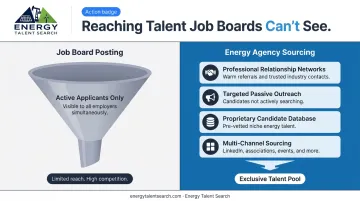
The most qualified energy professionals — senior reservoir engineers, offshore wind turbine specialists, grid infrastructure leads — are rarely browsing job boards. They're already employed, doing specialized work, and only move when the right opportunity is surfaced by a trusted contact.
That gap is where generalist recruiters fall short. When you post a job opening, you're competing for the same pool of active applicants every other company can see. The best candidates stay invisible to that process entirely.
An energy recruitment agency creates access through:
- Long-standing professional relationships built over years of sector-focused work
- Targeted outreach to professionals who aren't marketing themselves publicly
- Proprietary candidate databases developed through sustained industry presence
- Multi-channel sourcing that extends well beyond standard job boards
Energy Talent Search's approach to passive candidate sourcing is a deliberate, primary methodology — not a fallback. The agency's talent pipeline development work specifically focuses on headhunting passive candidates for niche engineering and technical positions, spanning oil and gas, renewables, and mining.
When this matters most: Niche technical roles (petroleum engineers, renewable project leads, offshore specialists) and senior or executive-level searches where the talent pool is thin and a delayed or mismatched hire carries real operational cost.
KPIs affected: Quality of hire, offer acceptance rate, 90-day retention, time-to-fill for specialized roles.
Advantage 2: Sector Fluency That Speeds Up Matching Without Cutting Corners
A generalist recruiter doesn't know the difference between a reservoir engineer and a production engineer. They don't understand what FERC compliance means for a specific role, or why oil and gas field experience might transfer directly to an offshore wind project.
So they over-rely on keyword matching and produce shortlists that waste everyone's time.
An energy recruitment agency operates differently. Recruiters who know the sector can:
- Brief candidates accurately on role expectations and technical requirements
- Ask the right screening questions during initial interviews
- Evaluate hybrid skill sets — for example, a petroleum engineer transitioning to a geothermal or offshore wind role
- Shortlist more precisely, reducing wasted interview rounds
The IEA has directly linked technical skills shortages to delayed projects, cost pressure, reduced operating capacity, and reliability risk across electricity, solar, wind, and hydrogen sectors. That's the operational exposure sitting behind every prolonged vacancy.
In practice, this means fewer interview rounds, better candidate fit, and faster hiring manager decisions. Internal teams spend less time re-running searches because early shortlists missed the mark — particularly during energy transition hiring, when cross-sector knowledge is essential and internal HR teams often lack the technical depth to evaluate candidates accurately.
KPIs affected: Time-to-fill, interview-to-offer ratio, hiring manager hours, first-year retention.
Advantage 3: Reduced Hiring Risk in High-Stakes, Safety-Critical Roles
Energy roles carry real consequences when filled with the wrong person. A poorly vetted hire in field operations, infrastructure management, or compliance-heavy roles can affect safety outcomes, project timelines, regulatory standing, and team cohesion — not just internal culture.
A specialized energy agency functions as a quality filter before a candidate reaches a hiring manager's desk.
Energy Talent Search's engagement process includes structured screening for both technical qualifications and cultural fit — assessing domain knowledge, problem-solving capability, and alignment with the hiring company's values before a shortlist is presented.
The financial case for getting this right is clear:
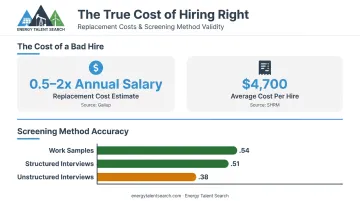
- Gallup estimates employee replacement costs at 0.5 to 2x annual salary, encompassing lost productivity, onboarding investment, and team disruption
- SHRM puts average cost per hire at nearly $4,700 — before accounting for a mis-hire that cycles back through the process
There's also a structural argument for more rigorous screening. The U.S. Office of Personnel Management assigns validity coefficients of .54 to work samples and .51 to structured interviews — compared to just .38 for unstructured interviews. That rigor translates directly into more accurate performance predictions.
When this matters most: Safety-sensitive field roles, compliance-heavy positions, project-based placements with hard deadlines, and team lead or executive hires where one misaligned person affects an entire department.
KPIs affected: Turnover rate, cost-per-hire, time-to-productivity, safety incident rates tied to staffing gaps.
What Happens When Energy Companies Hire Without Specialist Support
Relying on generalist hiring or an overloaded internal HR team for specialized energy roles creates predictable, compounding problems:
- Extended vacancies stall project timelines and push work onto existing staff who are already stretched
- Keyword-driven shortlists produce mismatched candidates who don't survive their first year
- Emergency hiring under deadline pressure leads to shortcuts in vetting — increasing the risk of exactly the mis-hire you were trying to avoid
- Repeated recruiting cycles multiply costs: refreshed job postings, repeated interview rounds, restarted onboarding
- Scaling gaps during energy transition surges leave companies flat-footed when demand spikes and the internal pipeline isn't ready
The IEA's 2025 data reinforces this directly: around 60% of more than 400 energy firms surveyed reported hiring difficulty caused by skills and labor shortages. That's not a niche problem — it's the baseline condition most energy companies are operating in right now. Renewable demand is about to make it harder.
Renewable energy hiring pushes this further. BLS projects 42% employment growth for solar photovoltaic installers and 50% for wind turbine service technicians between 2024 and 2034. These are roles that barely existed in meaningful numbers a decade ago, with no established generalist pipeline for sourcing them.
How to Get the Most Value from an Energy Recruitment Agency
The relationship works best when energy companies treat the agency as a strategic partner from day one — not a backup option when internal hiring stalls.
To maximize the engagement:
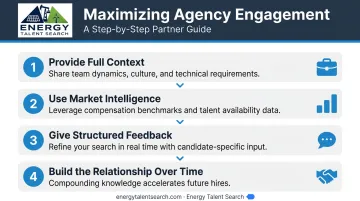
Provide full context upfront — team dynamics, technical requirements, culture, and growth trajectory. The more specific the brief, the more accurate the match. Energy Talent Search's process begins with a detailed discovery consultation precisely because this context shapes every sourcing and screening decision that follows.
Use the agency's market intelligence, not just their candidate pool — a good energy recruitment agency brings compensation benchmarks, talent availability data, and role-specific insights that sharpen hiring decisions and make offers more competitive against what top candidates are actually fielding.
Give structured feedback on every shortlisted candidate — this isn't just courtesy. It refines the search in real time, helping the agency recalibrate against your actual preferences rather than your initial brief.
Build the relationship over time — agencies that know your hiring history, team structure, and standards fill the next role faster than they filled the first. Regular check-ins keep that knowledge current.
That compounding value is where Energy Talent Search's model earns its place — a boutique, high-touch engagement running from discovery through post-placement, designed to get sharper with every search.
Conclusion
Hiring an energy recruitment agency gives you something general hiring can't: access to candidates who aren't on job boards, faster matches that hold, and a vetting process built for the technical and operational demands of the sector.
Those benefits also compound over time. Each placement builds the agency's working knowledge of your team, your standards, and what good looks like for your organization — making every search after the first one faster and more precise.
In a sector where talent is a direct operational input, getting the right people faster and keeping them longer isn't just an HR outcome. It's the difference between a project that hits its timeline and one that doesn't.
Frequently Asked Questions
Why hire a recruitment agency for energy sector roles specifically?
Energy roles require highly specialized technical skills, often from professionals who aren't actively job searching. A sector-focused agency reaches and vets these candidates far more effectively than general hiring methods, which are built for active applicant pools rather than passive, niche talent.
What types of energy roles can a recruitment agency help fill?
Energy recruitment agencies cover the full spectrum: field and engineering roles in oil, gas, and renewables, plus project management, executive leadership, technology, and accounting and finance. Niche placements include blade repair technicians, reservoir management specialists, and grid infrastructure leads.
How does an energy recruitment agency find candidates who aren't actively job searching?
Specialized agencies maintain long-standing professional networks, conduct targeted outreach, and use sourcing strategies that surface passive candidates not posting resumes publicly. Proprietary talent databases built over years of sector-focused work give agencies direct access to professionals no job board can reach.
Is it worth paying a recruitment agency fee for energy sector hiring?
The agency fee is modest compared to the cost of a vacant role, a mismatched hire, or a prolonged search. Gallup estimates replacing an employee costs 0.5 to 2 times their annual salary, making a strong placement one of the better returns a company can realize.
How long does it take an energy recruitment agency to fill a specialized role?
Timelines vary by role complexity and market conditions. A specialized agency with an active network typically moves faster than an internal team starting from scratch, especially for niche technical or executive roles where access depends on existing relationships.
Can a recruitment agency help with both traditional energy and renewable energy hiring?
Yes. Agencies with broad energy sector experience, spanning oil and gas, alternative energy, mining, and manufacturing, are equipped to recruit for both sides of the energy landscape, including roles that require cross-sector knowledge as the industry transitions.