

Staffing fees vary by placement model, role complexity, industry specialization, and how much risk the agency absorbs. This article breaks down each fee model, the factors that move costs up or down, what those fees actually pay for, and how to distinguish real value from a low headline rate.
Key Takeaways
- Direct hire fees typically run 18%–25% of first-year base salary, paid by the employer upon the candidate's start
- Contract staffing uses a markup model — the employer's bill rate includes the worker's pay plus employer taxes, insurance, and agency margin
- Executive and retained search fees reach 30%–35% of annual salary for senior-level roles
- Specialized sectors like energy command higher fees because the candidate pool is genuinely narrow
- The lowest fee isn't the lowest total cost: failed placements in technical roles cost roughly 80% of that employee's annual salary to recover
How Much Do Staffing Agencies Charge? (Fee Overview)
Staffing fees don't follow a single standard rate. The number you see depends on the placement model, the complexity of the role, and what services are actually bundled in. Employers who assume a flat-rate structure often encounter unexpected line items — or worse, discover the low rate came with a 30-day replacement guarantee that's already expired when a placement fails.
Two cost mistakes come up repeatedly:
- Underbudgeting by comparing headline percentages across agencies without understanding what each includes
- Overlooking downstream cost when a placement fails outside the warranty window and the employer absorbs full re-recruitment costs
Here's how the three main fee models work.
Direct Hire Placement Fees
According to Staffing Industry Analysts' 2022 survey data, 20% of first-year hiring salary was both the median and most common direct hire fee. Professional staffing firms typically fall in an 18%–22% midrange, while firms focused exclusively on direct hire reported a 20%–25% midrange.
Employers pay this fee — candidates pay nothing. Reputable agencies like ManpowerGroup explicitly state they do not charge job seekers for placement services.
What direct hire fees typically include:
- Job advertising and candidate sourcing
- Initial screening calls and structured interviews
- Reference checks and skills verification
- Offer coordination and support
- A replacement guarantee (terms vary widely)
What may be billed separately:
- Background checks and drug screening
- Pre-employment assessments
- Any role-specific compliance testing
Before signing, confirm exactly how long the replacement guarantee runs — 30-day and 90-day windows are common, but the gap between them can mean absorbing a full re-recruitment cost if a hire leaves at month two.
Contract and Temporary Staffing Markups
Contract staffing works differently. Instead of a one-time percentage fee, the agency adds a markup on top of the worker's hourly pay rate to arrive at your bill rate.
SHRM has reported markups reaching as high as 60% in some staffing arrangements — though this reflects the high end of the market, not a standard midpoint. The actual markup on any given engagement depends on the worker's pay rate, the state, the role's risk classification, and what the agency includes.
Simple example:
- Worker pay rate: $50/hour
- Markup: 40%
- Employer bill rate: $70/hour
W2 workers carry higher markups than 1099 contractors because the agency, as employer of record, absorbs several mandatory employer costs:
- Employer FICA: 7.65% of covered wages (2026 rate)
- State unemployment insurance: varies by state and claims history
- Workers' compensation: varies by role risk classification
- General liability coverage: standard in most agency contracts
Executive Search Fees
Beyond contract staffing, executive and senior-level roles operate under a separate fee structure entirely. Hunt Scanlon's 2024 industry data places retained search fees at 30%–35% of annual salary.
Two engagement models apply at this level:
| Model | When Fee Is Paid | Best Used For |
|---|---|---|
| Contingency | Only upon successful placement | Mid-level roles, faster searches |
| Retained | Portion paid upfront to begin search | Executive, VP, director-level roles |
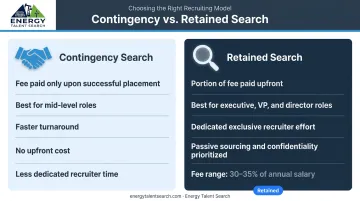
Retained search purchases dedicated recruiter effort and is standard for roles where passive sourcing, confidentiality, and deep market coverage matter most.
Key Factors That Affect Staffing Agency Fees
Three things drive fee differences more than anything else: role difficulty, salary baseline, and the terms of the engagement.
Role Complexity and Specialization
The harder a role is to fill, the higher the fee — and energy sector roles are consistently among the hardest. The DOE's 2024 Energy Employment Report found 76% of energy employers reported at least some difficulty hiring qualified workers. Engineers and scientists were the hardest category to fill for 38% of energy-efficiency professional employers and 31% of manufacturers.
A narrow candidate pool means passive sourcing, not just posting a job. Agencies with established networks in energy, technology, and finance — Energy Talent Search among them — reduce time-to-fill by reaching passive candidates before they enter the open market.
Industry, Geography, and Salary Baseline
For percentage-based fees, salary baselines determine absolute fee dollars. BLS May 2024 data for the Houston metro illustrate this clearly:
| Role | Mean Annual Wage | Illustrative 20% Fee |
|---|---|---|
| Petroleum Engineers | $184,370 | $36,874 |
| Financial & Investment Analysts | $118,110 | $23,622 |
| Project Management Specialists | $114,410 | $22,882 |
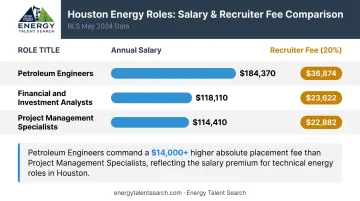
The same percentage rate produces a $14,000+ difference in absolute dollars depending on the role. Before comparing agency rates, confirm which salary figure the fee is calculated against — base only, or total compensation including bonus.
Volume, Exclusivity, and Relationship Terms
Fee structure also shifts based on how the engagement is structured. Employers placing multiple roles, granting exclusivity, or entering long-term agency partnerships often negotiate lower markup rates or reduced percentages. Urgent or one-off placements carry less leverage and sometimes a premium. Any rate adjustments for volume or exclusivity should be confirmed in writing before the search begins.
What Do Staffing Agency Fees Actually Cover?
The markup or placement percentage funds a bundle of services that would otherwise fall on your internal HR team. Understanding what's inside helps you compare agencies with different rate structures more accurately.
Recruiting and Sourcing
- Job advertising across relevant platforms
- Access to candidate databases and passive talent networks
- Outreach to professionals not actively on the market
- Initial screening calls, structured interviews, and skills assessments
- Specialized roles (petroleum engineers, renewable energy technologists) require sector-specific fluency that a generalist recruiter typically lacks
Employer-of-Record Costs (Bundled into Contract Markups)
- Employer FICA: 7.65% of covered wages
- Federal unemployment (FUTA): up to $42 per worker after standard credits
- State unemployment insurance (experience-rated, varies by state)
- Workers' compensation insurance (varies by occupation and jurisdiction)
- General liability coverage
These statutory costs typically account for 20–30% of the total markup before any agency margin or recruiting expense is factored in.
Post-Placement Support
- Offer coordination and candidate communication
- Onboarding assistance
- Replacement guarantees — terms range from 30-day minimums to longer warranty windows
- Ongoing account management
Agencies with longer replacement guarantees signal higher confidence in their vetting process. A 30-day window shifts replacement cost back to the employer ; a 90-day or longer guarantee gives the employer meaningful protection.
Low-Cost vs. Higher-Cost Staffing Agencies: What's the Difference?
A lower headline fee doesn't automatically mean lower total cost. Three dimensions separate agencies at different price points:
| Dimension | Lower-Cost Agency | Higher-Cost Specialist |
|---|---|---|
| Screening rigor | Resume review, basic phone screen | Structured interviews, reference checks, skills verification |
| Industry expertise | Generalist across many sectors | Deep sector fluency to assess technical competency |
| Replacement terms | 30-day guarantee common | Longer warranty windows, stronger post-placement protection |
Those differences matter most when a placement fails. Gallup estimates replacement cost at approximately 80% of salary for technical professionals and around 200% for leaders and managers. SHRM puts the range at 50%–200% of annual salary, depending on seniority.
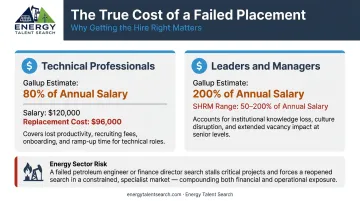
At a $120,000 salary, a failed technical hire costs roughly $96,000 to replace — including lost productivity, re-recruitment, and onboarding. A placement fee "saved" by choosing a lower-rate generalist agency can be erased by a single failed placement.
For energy sector employers, the stakes are higher still. A failed petroleum engineer or finance director search stalls active projects, fractures team continuity, and reopens a search in a market where qualified candidates are already hard to find.
What Most Employers Get Wrong About Staffing Agency Costs
Focusing Only on the Headline Percentage
Two agencies quoting 20% can deliver completely different service scopes. Always request an itemized breakdown of what the fee includes and what gets billed separately.
Overlooking Secondary Fees That Compound Total Cost
Ask specifically about these items — and get all of them in writing before signing:
- Conversion fees when a temp worker transitions to permanent hire
- Minimum billing hour requirements
- Cancellation fees for early assignment termination
- Background check and drug screening charges (typically billed separately)
- Rush premiums for compressed timelines
Treating All Placements as Equivalent Cost Decisions
A failed entry-level hire is recoverable. A failed senior engineer or finance director search in a specialized market is not.
The downstream costs are disproportionate:
- Lost productivity during the vacancy and restart period
- Team disruption from a misaligned or short-tenured hire
- Re-recruitment in a constrained talent pool
- Project delays with real schedule and budget consequences
The placement fee should be weighed against the full cost of failure, not compared to a competing agency's rate in isolation.
Conclusion
Staffing agency fees vary significantly by model, role type, industry, and service scope. The structure behind the number matters more than the number itself. A 20% fee from a specialist agency with a 90-day replacement guarantee and genuine passive candidate access is a fundamentally different proposition than a 20% fee from a generalist firm relying on active candidates and a 30-day window.
For employers in energy, technology, and manufacturing, what separates a worthwhile fee from an expensive mistake is usually the agency's depth in your sector — their access to passive candidates, knowledge of role-specific requirements, and commitment to placements that hold. Energy Talent Search works with employers across oil and gas, renewables, mining, and related industries to do exactly that. Reach the team at info@energytalentsearch.com or (720) 260-4250 to talk through your hiring needs.
Frequently Asked Questions
Frequently Asked Questions
How much do staffing agencies charge?
Direct hire fees typically fall in the 18%–25% range of the candidate's first-year base salary, paid by the employer upon hire. Contract and temporary staffing uses a markup model on top of hourly pay. Executive retained search fees reach 30%–35% of annual salary. Rates vary by role complexity, industry, and agency.
Are staffing agencies worth using?
For specialized or senior roles, the answer is generally yes. Internal recruiting time, bad-hire risk, and limited access to passive candidates all carry real costs. In tight talent markets like energy, a specialist agency with an established network reduces time-to-fill and consistently outperforms what most in-house teams can achieve on their own.
What is a staffing agency markup, and what does it include?
The markup is the percentage added above a worker's hourly pay rate. It covers employer-side payroll taxes (FICA, FUTA, state UI), workers' compensation insurance, general liability, recruiting costs, and agency margin. A significant portion goes to statutory employment costs before any margin is counted.
What is the difference between a contingency fee and a retained search fee?
Contingency fees are paid only when a candidate is successfully placed. Retained search requires a portion of the fee upfront, in exchange for dedicated, exclusive search effort — standard for executive, VP, and director-level roles where passive sourcing and confidentiality are priorities.
Do candidates pay any staffing agency fees?
No. Reputable staffing agencies are paid exclusively by the employer. Candidates pay nothing for placement services. Any agency asking candidates to pay fees to be placed is a significant red flag.
Can employers negotiate staffing agency fees?
Most agencies will negotiate, particularly for high-volume hiring, long-term partnerships, or exclusive arrangements. Beyond the rate itself, push for clear replacement guarantee terms and get all fee structures, secondary charges, and warranty conditions documented in writing before signing.