Introduction
Filling a petroleum engineer, drilling supervisor, or utility-scale solar project manager role through job postings alone is a losing strategy. The professionals you actually want — the ones with the certifications, field hours, and project track record — are already deployed somewhere else.
Energy hiring managers struggle with a shrinking active candidate pool — and the numbers confirm it. According to the U.S. Department of Energy's 2024 Energy & Employment Report, 76% of U.S. energy employers reported at least some difficulty hiring qualified workers, with that figure climbing to 85% in electric power generation. Active candidate pools simply don't contain enough specialized talent to close that gap.
Passive recruiting changes the math. Instead of waiting for candidates to find you, you reach employed professionals who aren't browsing job boards but may be open to the right conversation. This guide covers:
- What passive recruiting looks like in practice for energy roles
- Where to find passive energy talent before competitors do
- How to approach candidates without burning the relationship
- How to build an employer brand that makes outreach land
Key Takeaways
- Passive candidates dominate the energy workforce — reaching them requires a relationship-first approach, not a job posting
- Energy roles demand certifications, field experience, and regulatory knowledge that active candidate pools rarely cover at the volume most hiring managers need
- Top sourcing channels include industry conferences, LinkedIn Boolean search, employee referral programs, and specialized recruitment partners
- Effective outreach is personalized and career-focused, speaking to a candidate's trajectory rather than a role's requirements
- A strong employer brand dramatically increases passive candidates' willingness to respond
What Is Passive Recruiting? Active vs. Passive Candidates Explained
Passive recruiting is the practice of proactively identifying and engaging employed professionals who are not actively searching for a new job — but who may be open to the right opportunity.
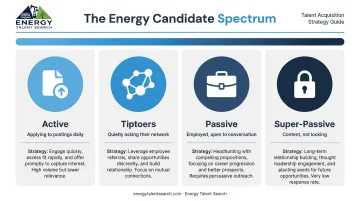
Understanding where candidates sit on the spectrum helps you tailor your approach:
| Candidate Type | Behavior | Strategy |
|---|---|---|
| Active | Applying to postings, checking job boards daily | Post jobs, respond quickly |
| Tiptoers | Quietly asking their network, updating their resume | Referrals, LinkedIn outreach |
| Passive | Employed, open to conversation if approached well | Relationship-based, personalized outreach |
| Super-passive | Content, not looking, unlikely to move | Long-term brand building only |
Passive candidates represent the largest and highest-quality segment of the energy talent market. A senior reservoir engineer, for example, might be performing well at their current operator, with no updated resume and no Glassdoor searches — but they'd absolutely take a call about a high-complexity unconventional play or a deepwater project that their current role can't offer — paired with a stronger compensation structure. That's your target.
Energy companies benefit from having strategies across all four groups. In practice, though, passive candidates yield the highest-quality conversations — because you're reaching people before they're on anyone else's radar. The sections below show you how to find and engage them.
Why Passive Recruiting Is Especially Critical in Energy Hiring
The Talent Scarcity Problem Is Structural
Energy roles aren't just hard to fill — they require years of accumulation that can't be fast-tracked. Petroleum engineers need specialized certifications and formation-specific field experience. Utility-scale solar project managers need to understand interconnection agreements, permitting timelines, and EPC contractor management. Regulatory knowledge in oil and gas is jurisdiction-specific and takes years to develop.
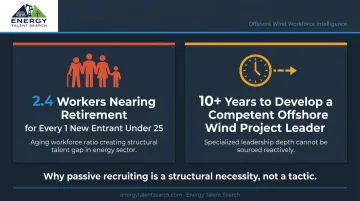
The IEA's World Energy Employment 2025 report documented that more than half of 700 surveyed energy organizations reported critical hiring bottlenecks — with electricians, pipefitters, line workers, plant operators, and nuclear engineers among the shortest-supply roles globally. The report also found 2.4 workers nearing retirement for every new entrant under 25 in advanced-economy energy workforces. That retirement pressure compounds the supply problem every year.
Active-Only Recruiting Falls Short
When you post a job for a drilling engineer or offshore wind project manager, the most qualified candidates are not refreshing job boards. They're deep in active projects, on job sites, or managing their current teams.
The professionals who do respond to cold postings skew toward those between roles, early in career, or actively dissatisfied — a narrower, less specialized slice of the overall talent pool.
The Energy Transition Creates a Unique Opening
Many experienced oil and gas professionals are watching the renewable energy sector with genuine interest but haven't taken action. They have transferable technical skills — project execution, reservoir mechanics, subsurface analysis, large-capital operations management — but haven't been approached with a compelling reason to cross over.
This creates a specific window for renewable energy, mining, and energy infrastructure companies to reach technically skilled O&G professionals before competitors do. According to S&P Global, developing a competent offshore wind project leader typically takes more than 10 years — which means the energy transition skills gap was already a bottleneck before the sector's rapid expansion. For companies actively hiring, proactive outreach to professionals considering a transition is one of the few ways to get ahead of that gap before it becomes a crisis.
The Cost of Staying Reactive
That opportunity window closes fast when hiring stays reactive. Every week an engineering or technical role sits unfilled drives delayed projects, overloaded teams, and deferred revenue. Passive recruiting builds a warm talent pipeline so that when a role opens, qualified candidates are already identified — not discovered for the first time.
Where to Find Passive Energy Talent: Top Sourcing Channels
Niche Industry Events and Associations
No job posting replicates what happens at an industry conference. These events concentrate employed professionals in one place:
- OTC (Offshore Technology Conference) — Houston, ~25,000 energy professionals per event
- CERAWeek by S&P Global — Houston, 10,000+ participants from 89 countries, 1,620+ C-suite executives
- RE+ — North America's largest clean energy event, with 37,000+ professionals at RE+ 2025
- Society of Petroleum Engineers (SPE) — Global upstream O&G body with 59,000+ student members and professionals in 145 countries
- IEEE Power & Energy Society — 40,000+ members across 950+ chapters
The mandate for anyone you send to these events: build relationships, not hiring pipelines on the spot. Exchange contacts, ask about their work, and follow up with relevant opportunities over time. Sponsorship also builds brand visibility with passive audiences who may not have heard of your organization.
LinkedIn and Boolean Search
LinkedIn's advanced search lets you filter for passive candidates by job title, certifications, geography, years of experience, and company — all without them actively applying. Energy professionals frequently maintain detailed profiles even when not job searching.
Boolean search makes the targeting more precise. A string like "reservoir engineer" AND ("unconventional" OR "tight oil" OR "shale") surfaces profiles combining multiple energy-specific terms. You can layer in location, seniority, or certification terms to narrow further. LinkedIn Recruiter's InMail function gives you direct access to professionals outside your network — and LinkedIn's own research found that 63% of professionals feel flattered when a recruiter contacts them, provided the outreach is personalized.
Employee Referral Programs
Your current technical staff have direct professional relationships with equally qualified peers — former classmates from petroleum engineering programs, colleagues from field rotations, contacts from prior operators. A structured, incentivized referral program taps that network without requiring you to discover it from scratch.
The advantage for passive candidates specifically: a trusted peer's recommendation carries weight that cold outreach cannot replicate. An employed professional is far more likely to take a call when it comes through someone they already respect.
Specialized Energy Recruitment Partners
For companies that lack internal sourcing bandwidth — or need to fill senior and executive energy roles quickly — working with a firm like Energy Talent Search gives immediate access to a pre-built pipeline of vetted passive candidates across oil and gas, renewable energy, mining, manufacturing, and energy finance. These candidates are not visible on public job boards and would not respond to a standard posting.
For niche technical and executive roles, this matters most. Firms that specialize in energy recruitment bring the domain knowledge needed to assess candidates accurately — something that's difficult to replicate without deep sector context.
How to Engage Passive Energy Candidates Effectively
Personalize Every Outreach
Generic messages get ignored. Passive energy professionals receive templated InMails constantly — a message that could have been sent to 200 other people will read exactly like that.
Effective outreach references something specific: a project they contributed to, a technical publication, a certification they hold, or a mutual professional connection. The first message should feel like a professional conversation, not a pitch.
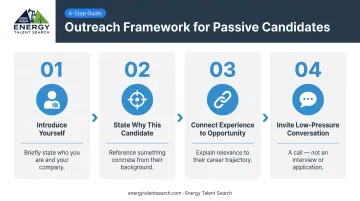
A simple framework for the first outreach:
- Introduce yourself — briefly, with context (who you are, your company, why you're reaching out)
- State why this candidate specifically — mention something concrete from their background
- Connect their experience to the opportunity — explain what makes this relevant to their career, not just your opening
- Invite a low-pressure conversation — not an interview, not an application — just a call
Lead with Career Value, Not Just the Role
Passive energy professionals are already succeeding where they are. The pitch must answer why would this be better for my career? — not just restate a job description.
Rigzone's global retention survey of over 27,000 employed oil and gas professionals ranked better career opportunities first, ahead of work-life balance and compensation. Broader LinkedIn research on job changers found that 59% joined a new employer because of a stronger career path, with better compensation/benefits second at 54%.
That means your outreach should address:
- Expanded project scope or technical complexity
- Access to new technology or a different energy segment (for example, moving from conventional to offshore wind)
- Leadership development or promotion path
- Equity, production bonuses, or compensation upside
- Geographic flexibility or schedule structure
If you can't speak to at least two of these specifically for the candidate you're approaching, the outreach isn't ready.
Build the Relationship Before the Role Exists
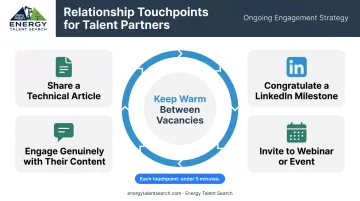
Passive recruiting is a long game. Hiring managers who only reach out when a vacancy opens are always playing catch-up. A stronger approach: maintain periodic contact with 10–15 pre-engaged candidates in priority disciplines (reservoir engineers, solar project managers, energy accountants) so that when a role opens, you already have a warm list.
Touchpoints to maintain contact between vacancies:
- Share a relevant technical article or industry report
- Congratulate a professional milestone on LinkedIn
- Invite them to a company-hosted event or webinar
- Comment genuinely on their professional activity
Each of these takes under five minutes — and they're what separate a cold outreach from a warm conversation when a role finally does open.
Streamline the Process for Employed Candidates
Passive candidates are time-constrained and not desperate. A multi-stage formal application will lose strong energy candidates who have no urgency to jump through hoops.
Adjustments that reduce friction:
- Offer a profile-based first step instead of a lengthy application form
- Consolidate interview rounds — two well-structured conversations beat four fragmented ones
- Schedule around their availability — evenings, video calls, flexible windows
- Respond within 48 hours between stages; delays signal disorganization and give competitors an opening
Building Your Employer Brand to Attract Passive Energy Professionals
Passive candidates do their own due diligence before responding to outreach. They check Glassdoor, LinkedIn company pages, industry news, and forums. Your outreach is only as effective as the brand behind it. Glassdoor research found that 83% of U.S. job seekers research company reviews and ratings before deciding where to apply — and passive candidates are no different.
What to invest in:
- Your LinkedIn company page should reflect active projects, team culture, and growth opportunities — not function as a press release feed
- Your career site needs enough specificity that a petroleum engineer can tell what kind of work they'd be doing and who they'd be working with
- Your Glassdoor presence matters: responding to reviews signals that leadership pays attention
Thought leadership as a brand signal:
A passive candidate who's already encountered your company's thinking at a conference or in a technical journal is far more receptive when outreach arrives. Ways to build that presence:
- Contribute to industry publications on project-specific topics
- Speak at OTC, CERAWeek, or regional energy forums
- Publish technical white papers or case studies
- Host webinars on relevant engineering or operational challenges
Current employees as brand amplifiers:
Satisfied engineers and project managers posting genuine content about their work on LinkedIn carry more credibility than any corporate marketing copy. Encourage it. An employed passive candidate is far more likely to respond to outreach if they've already seen positive, authentic voices associated with your organization.
Frequently Asked Questions
What is the difference between active and passive recruiting?
Active recruiting responds to candidates who are already searching — through job boards, postings, and applications. Passive recruiting proactively targets employed professionals who are not searching, requiring a more relationship-based, personalized approach rather than a reactive one.
What is an example of a passive candidate?
A mid-career petroleum engineer performing well at their current operator, not browsing job boards, but who might consider a conversation if approached with expanded project scope, a stronger compensation package, or an opportunity to move into a technically challenging new segment.
What are the three types of recruitment?
The three types are internal recruitment (promoting or transferring existing employees), external active recruitment (job postings and inbound applications), and external passive recruitment (proactive outreach to employed professionals who aren't seeking). Most energy companies use all three — passive sourcing fills the gaps the other two can't reach.
How long does it typically take to hire a passive candidate?
Longer than active hiring — passive candidates need time to weigh leaving a stable role. From first outreach to offer acceptance, timelines commonly run several weeks to a few months. Building a warm pipeline before roles open cuts that timeline significantly.
How do you approach a passive energy candidate without turning them off?
Lead with genuine personalization — reference their specific background, not a generic role description. Keep the initial ask low-pressure (a conversation, not an interview request), and focus on career value rather than urgency. Candidates who sense a recruiter has done their homework are far more likely to engage.
When should an energy company work with a specialized recruiting agency for passive hiring?
When filling senior, technical, or executive roles; when internal sourcing capacity is limited; or when speed matters. Energy Talent Search maintains an established network of passive candidates across oil and gas, renewable energy, mining, and energy finance that no job posting can reach.