
In that environment, defaulting to a large generalist staffing firm isn't just inconvenient — it's a real operational risk. Recruiters without energy sector knowledge can't evaluate technical credentials accurately, and a missed qualification in a safety-critical role carries consequences that extend well beyond a failed placement.
This article explains why boutique recruiting consistently delivers better outcomes for energy hiring — and what energy companies should look for when choosing a recruiting partner.
Key Takeaways
- Boutique energy recruiters bring sector-specific expertise that generalist firms can't replicate at scale
- Energy hiring is hard because of qualification gaps, not a shortage of candidates — and that distinction changes how you recruit
- Access to passive candidates matters more in energy than most industries, where top performers are rarely between jobs
- Fewer, better-screened candidates reduce hiring manager time and mis-hire risk
- The strongest recruiter-client partnerships begin with deep context — culture, team dynamics, and role expectations — not just a job description
What Is Boutique Recruiting?
A boutique recruiting agency is a small, specialized firm that focuses on a limited number of industries or role types — prioritizing depth of expertise and personalized service over breadth and volume.
Where large generalist firms measure success in placements per month across dozens of sectors, boutique firms measure it in placement quality within a narrow field. Their focus stays on specialized, technical, and leadership roles — the positions where a wrong hire creates downstream problems that take months to untangle.
In practice, boutique recruiting shows up most clearly in industries where credentials are highly specific and stakes are high — energy, finance, mining, and technology among them. A misaligned hire in these fields rarely stays contained to the HR department.
Agency size is part of it, but the more meaningful difference is what the firm is optimized for. Boutique recruiters are built around placement quality, lower turnover, and reduced hiring risk — not maximizing the number of roles filled each month.
Key Advantages of Boutique Recruiting for Energy Hiring
The advantages below connect directly to what makes energy sector hiring distinctly difficult: technical specificity, talent scarcity, high operational stakes, and the pressure of an ongoing industry transition.
Deep Energy Sector Expertise
Boutique energy recruiters bring working knowledge of the roles they fill. A petroleum engineer and a reservoir engineer are not interchangeable. Recruiters who don't know that distinction will burn three weeks of a hiring manager's time presenting the wrong shortlist.
This expertise shows up in practical ways:
- Screening for the right safety credentials (OSHA, HAZWOPER, well control certifications, offshore survival training) rather than treating them as interchangeable
- Understanding subsector distinctions — upstream, midstream, downstream, and renewable all require different skill sets and compliance knowledge
- Asking technical screening questions that surface real competency, not just keyword matches on a resume
Generalist recruiters sourcing for energy roles typically rely on title and keyword matching. When the role has a 12-month learning curve or sits in a safety-critical environment, those shallow matches become expensive.
The DOE identifies insufficient certifications, deficient experience, and missing technical skills as the primary causes of energy hiring difficulty. These are precisely the gaps that generalist screening misses most often.
When this matters most: Technical mid-level to senior roles (engineers, project managers, HSE specialists, operations leads), and for companies expanding into new energy segments — such as a conventional oil and gas operator building their first renewable energy team.
KPIs impacted: Time-to-fill, quality of hire, interview-to-offer conversion rate, hiring manager satisfaction.
Access to Passive Candidates in a Talent-Scarce Market
The best petroleum engineers, renewable project developers, and HSE managers are already employed. They're not browsing job boards. Reaching them requires direct outreach through a network built on years of industry involvement, referrals, and trust.
Boutique energy recruiters maintain these networks because their entire practice is built around a single sector. Energy Talent Search specifically focuses on headhunting passive candidates for niche and hard-to-fill technical roles. These professionals would never surface through a standard job posting, but they will take a call from a recruiter they've worked with or been referred to.
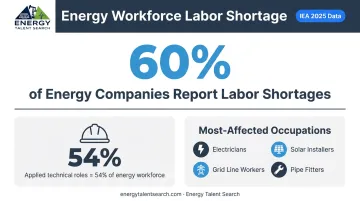
IEA's 2025 World Energy Employment report found that roughly 60% of energy companies reported labor shortages, with acute pressure in applied technical roles including electricians, grid line workers, solar installers, and pipe fitters. Applied technical occupations account for 54% of the energy workforce — and most of those workers aren't actively job-seeking.
Companies that rely solely on job postings are recruiting from the active minority. Boutique firms reach the full talent pool.
When this matters most: Capital project ramp-ups, energy transition team builds, and senior or rare specializations where the qualified candidate pool numbers in the hundreds, not thousands.
KPIs impacted: Candidate quality, offer acceptance rate, 12-month retention, competitive positioning in talent acquisition.
Tailored Search Process That Reduces Mis-Hire Risk
Boutique firms invest time upfront to understand more than the job description. Before sourcing begins, a good boutique energy recruiter will want to know:
- Team structure and dynamics
- Leadership style and management culture
- Growth trajectory and what this role needs to look like in 18 months
- Previous hiring pain points and where past candidates have underperformed
The result is a smaller shortlist, but one where each candidate has been evaluated against both technical requirements and cultural fit. That approach directly reduces mis-hire risk.
Replacing an employee can cost one-half to two times their annual salary, according to Gallup. That's the baseline for general turnover. In energy, the costs compound further: project delays, regulatory exposure, team disruption, and the full cycle of re-recruiting and onboarding.
Large generalist agencies operating at volume don't have the capacity to run this kind of tailored process. They're incentivized by volume, which produces candidates who look adequate on paper but often leave within 12 months.
When this matters most: Leadership roles, positions with long onboarding curves, and any role in a safety-critical environment where a poor hire carries operational and regulatory consequences.
KPIs impacted: 90-day and 12-month retention, cost-per-hire, hiring manager time saved, repeat recruitment frequency.
What Happens When Energy Companies Rely on Generalist Recruiters
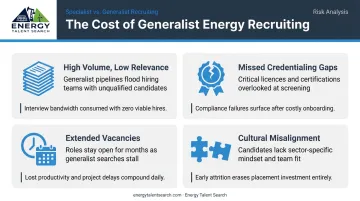
Relying on generalist recruiters for technical energy roles creates predictable, costly problems.
- High volume, low relevance: Hiring managers spend hours reviewing candidates who don't meet basic technical thresholds, consuming time that should go toward actual evaluation
- Missed credentialing gaps: A generalist unfamiliar with HAZWOPER requirements, well control certifications, or the difference between upstream and midstream compliance may present a candidate with critical gaps they never noticed
- Extended vacancies: The IEA has directly linked labor shortages to delays affecting 53 GW of U.S. solar projects in 2024 — a concrete illustration of what happens when technical roles stay open too long
- Cultural misalignment: Field-based and corporate energy roles carry very different culture requirements; generalists often can't make that distinction, leading to placements that technically qualify but don't last
Companies that cycle through poor hires — or rely on reactive recruiting instead of a proactive talent partnership — consistently pay more over time. Repeat agency fees, lost productivity, and vacant roles during narrow project windows compound into costs that far exceed any upfront savings from using a generalist firm.
How to Get the Most Value from a Boutique Energy Recruiter
The relationship works best when it starts with full transparency. Share your complete context — not just the job description, but your team structure, culture, growth plans, and any previous hiring pain points.
Energy Talent Search uses that context to shape the search strategy from day one — targeting the right candidate profiles, not just the available ones. The more detail you share upfront, the sharper the shortlist.
A few practical recommendations:
- Give ongoing feedback. Responding to candidate presentations and flagging role changes early keeps the search on track and reduces time lost to misaligned submissions
- Be honest about previous failures. If a role has been open for six months and two previous recruiters couldn't fill it, that context shapes where to look and who to target
- Expect candor in return. A boutique recruiter worth working with will tell you when a role falls outside their network — and refer you to someone better positioned. That willingness to walk away from a fee is a stronger indicator of a trustworthy partner than any sales pitch
Conclusion
In the energy sector, recruiting quality is a business-critical decision. Technical complexity, talent scarcity, and operational stakes are too high for a generic hiring process to hold up. The gap between a good hire and a poor one in a safety-critical or project-dependent role is measurable — in project timelines, team performance, regulatory risk, and repeat hiring costs.
Boutique energy recruiting addresses that gap through sector expertise that screens candidates accurately, passive candidate networks that reach talent job boards don't, and a tailored process that reduces the probability of a costly mis-hire.
Those advantages compound over time. When the recruiter-client relationship is built on communication and trust, placements get stronger with each search — not just faster.
That relationship starts with choosing the right partner. For energy companies, it means selecting a firm with genuine sector depth, a passive candidate network, and the accountability to stand behind every placement. Energy Talent Search is built around exactly that model — specialized, relationship-driven recruiting for the energy industry's most critical roles.
Frequently Asked Questions
What is a boutique recruiting agency?
A boutique recruiting agency is a small, specialized firm focused on a limited number of industries or role types. Unlike large generalist agencies that prioritize volume across many sectors, boutique firms emphasize depth of expertise, personalized service, and placement quality — making them well-suited for technical, safety-critical, or leadership roles where candidate fit matters most.
How can I tell if a boutique recruiting agency is legitimate?
Look for verifiable industry experience, transparency about their process and fee structure, and references or testimonials from clients in your specific sector. A credible boutique firm will ask substantive questions about your business, team, and culture before proposing any candidates — not just collect a job description and send names.
What is the 70/30 rule in hiring?
The 70/30 rule holds that roughly 70% of the workforce is passively employed while 30% are active job seekers. In tight technical markets like energy, that skew toward passive candidates is even more pronounced, making proactive outreach by specialized recruiters especially valuable.
What makes energy sector hiring different from other industries?
Energy roles combine strict credential requirements, safety-critical environments, and rapid role evolution driven by the energy transition. Add in the geographic concentration of specialized talent, and you have a hiring landscape that generalist recruiters are rarely equipped to navigate.
How long does boutique energy recruiting typically take compared to generalist firms?
Timelines vary by role and market conditions, but boutique firms typically deliver a smaller, pre-vetted shortlist faster. That cuts the back-and-forth of reviewing poorly matched candidates, saving hiring managers significant time even when the overall fill timeline is similar.
Can a boutique recruiting firm help with both oil and gas and renewable energy hiring?
The best boutique energy firms maintain expertise across both traditional and renewable sectors. Energy Talent Search covers the full spectrum from upstream oil and gas to solar and wind project development. For conventional operators building their first renewable teams, working with a firm that understands both sides of the energy transition is a genuine advantage.