Introduction
Energy hiring managers face a specific, recurring problem: the roles that matter most are also the hardest to fill. Drilling engineers, HSE specialists, project managers, and renewable energy developers don't show up reliably on job boards — and when they do, they're often already fielding multiple offers.
That pressure pushes many companies toward external recruiting help. Contingency recruiters are a natural first call, especially when speed matters and budget is constrained. The model has real trade-offs — and understanding them upfront changes how you use it.
This guide covers what contingency recruiting actually is, why it's particularly relevant in the energy sector, how the process works from intake to placement, and — critically — when it's the right call versus when retained search is a better fit.
Key Takeaways
- Contingency recruiters are paid only upon a successful hire — no placement, no fee.
- Energy's talent scarcity makes specialist recruiters far more effective than generalist ones.
- The model works best for mid-level, technical, or time-sensitive roles.
- Your engagement quality directly determines the quality of candidates you receive.
- Contingency and retained search solve different problems; knowing which to use saves time and money.
What Is a Contingency Recruiter?
A contingency recruiter is an external recruiter or firm hired to source candidates for open roles and paid only if their candidate is successfully hired, commonly called a "no placement, no fee" arrangement.
Fee Structure
According to SHRM, contingency recruiters typically charge 20%–25% of a candidate's first-year cash compensation (salary, bonus, and signing bonus combined). That fee is triggered only when the candidate accepts an offer and starts the role.
Compare that to:
- Internal recruiters: A fixed salary cost regardless of hiring outcomes
- Job board postings: Lower upfront cost but no sourcing, screening, or outreach
Contingency vs. Retained Search
The key structural differences:
| Factor | Contingency | Retained |
|---|---|---|
| Payment trigger | Only upon successful placement | Upfront retainer, regardless of outcome |
| Exclusivity | Non-exclusive — you can use multiple firms | Exclusive engagement |
| Fee benchmark | ~20%–25% of first-year cash comp | ~33% of salary, bonus, and signing bonus |
| Best fit | Mid-level technical roles (reservoir engineers, HSE managers, project leads) | VP of Operations, C-suite, or confidential executive searches |
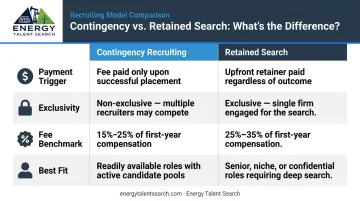
The non-exclusive structure lets you engage multiple agencies simultaneously. That parallel approach speeds up candidate flow, but managing several firms at once does require clear communication protocols — something this guide addresses in a later section.
Why Energy Companies Rely on Contingency Recruiters
The Talent Scarcity Problem
Energy hiring is difficult in ways that generic recruiting tools don't address well. The 2025 U.S. Energy & Employment Report from the DOE found that 88%–94% of employers across energy sub-sectors reported at least some hiring difficulty in 2024 — with wind manufacturing at 93%, wind wholesale trade at 94%, and fuels manufacturing at 91%. The DOE identifies insufficient experience, technical skills, and qualifications as the primary drivers.
These aren't roles you fill by posting on a general job board and waiting.
Passive Candidates Dominate the Market
The most in-demand energy professionals — petroleum engineers, senior project managers, field supervisors — are employed and not actively searching. They won't see your posting. Reaching them takes direct outreach through established industry relationships, which generic job boards simply can't replicate.
Specialized contingency recruiters like Energy Talent Search focus on exactly this. Their networks across oil and gas, renewables, and mining surface candidates through referral chains and long-standing professional relationships — cutting weeks off the time-to-shortlist for hard-to-fill roles.
High-Velocity Hiring Scenarios
Project ramp-ups, asset acquisitions, and rapid expansion into new energy verticals create sudden headcount needs that internal HR teams can't absorb alone. A contingency recruiter can mobilize quickly without requiring upfront budget commitment — particularly valuable for:
- Smaller operators and mid-size E&P companies
- Firms entering new markets (for example, transitioning from oil and gas into solar or wind)
- Companies with lean internal HR functions
Geographic Concentration
Energy roles cluster in specific regions — Texas alone held nearly 970,000 energy jobs in 2023, according to DOE state-level data. Recruiters with established networks in the Permian Basin, Gulf Coast, Appalachia, or offshore markets can locate candidates faster than broad-based searches. The DOE also found that 45% of electric-power-generation employers identified location or facility remoteness as their most significant hiring barrier — a problem that outreach-based recruiting directly addresses. For roles in remote or geographically concentrated markets, a recruiter with regional depth isn't a luxury — it's the practical difference between a 30-day fill and a 90-day vacancy.
How the Contingency Recruiting Process Works in Energy Hiring
Understanding the process helps you set realistic expectations and stay appropriately involved at each stage.
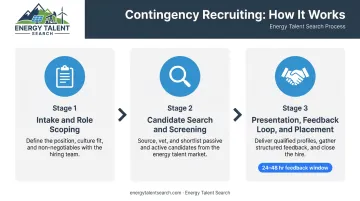
Step 1: Intake and Role Scoping
The search begins with a detailed briefing from the hiring manager. A strong intake covers:
- Technical requirements (certifications, software, field experience)
- Compensation range and benefits
- Team context and management style
- Operational environment (upstream vs. midstream, onshore vs. offshore, etc.)
- Any factors that caused prior hires to fail
In technical energy roles, vague intake is costly. A job description that says "5+ years of oil and gas experience" without specifying upstream vs. midstream context, equipment familiarity, or regulatory exposure will produce mismatched candidates. Spending an extra 20 minutes on intake typically eliminates multiple rounds of mismatched candidate submissions.
Step 2: Candidate Search and Screening
The recruiter sources candidates through their existing network, direct outreach to passive professionals, and screening against the criteria established in intake. A good energy-sector recruiter filters against domain-specific qualifiers beyond job title.
That means distinguishing between:
- Upstream vs. midstream vs. downstream experience
- Specific regulatory or permitting familiarity
- Equipment or software proficiency (e.g., SCADA systems, drilling software)
- Onshore vs. offshore operational context
Step 3: Presentation, Feedback Loop, and Placement
The recruiter presents a shortlist of pre-screened candidates. What you do at this stage directly affects candidate drop-off rates. SHRM research found that 47% of candidates withdrew from processes due to poor communication and 36% because of excessive process friction — both are within a hiring manager's control.
Respond to candidate submissions within 24–48 hours with specific feedback:
- ❌ "Not quite what we're looking for"
- ✅ "Lacks offshore field experience — we need someone who's worked on fixed platforms specifically"
Specific feedback lets the recruiter recalibrate immediately. Vague feedback costs the recruiter days of recalibration. After interviews, the recruiter manages offer negotiation, and the contingency fee triggers upon the candidate's start date.
What to Look for in an Energy-Sector Contingency Recruiter
Not all contingency recruiters are equally useful for energy hiring. Four things separate a strong energy recruiter from a generic one:
1. Sub-sector knowledge A recruiter unfamiliar with the difference between an upstream production engineer and a midstream pipeline engineer will surface candidates who look right on paper but lack operational context. Ask what percentage of their placements have been in energy and which sub-sectors they cover.
2. Access to professionals not actively job hunting The recruiter's ability to reach professionals who aren't actively looking — through genuine relationships, not just LinkedIn searches — is the primary value-add.
Ask specifically how they keep their energy network warm and what their outreach process looks like between active searches.
3. Vetting process depth Before engaging, find out how many touchpoints they have with each candidate and whether they verify technical credentials or just screen resumes. A recruiter who calibrates their vetting criteria with you upfront sends quality candidates, not high-volume submissions.
4. Guarantee terms — in writing Understand what happens if a placed candidate leaves within a short window. Reputable firms offer a defined replacement guarantee period, but policies vary significantly. Get the terms in writing before engaging — verbal assurances aren't binding.
How to Work Effectively With a Contingency Recruiter
The contingency model runs on momentum. Three habits protect it:
- Full context at intake: Share more than the job description — cover company culture, team dynamics, management style, and why previous hires in the role didn't work out. Specificity upfront shortens the search.
- Fast, specific feedback: Aim for 24–48 hours on candidate submissions. Detailed responses keep the search moving and signal that the role is a priority.
- Immediate communication on changes: If requirements shift, headcount pauses, or an internal candidate surfaces, notify your recruiter right away. Outdated criteria mean wasted sourcing effort on both sides.
Contingency vs. Retained Recruiting: Which Model Fits Your Energy Role?
When Contingency Works Best
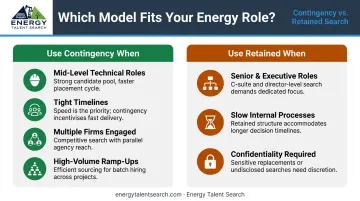
Contingency recruiting fits well when the role is mid-level, the timeline is tight, and your team can move fast on strong candidates:
- Mid-level technical roles (project engineers, field supervisors, HSE specialists, land professionals)
- Time-sensitive searches where engaging multiple firms to accelerate the process makes sense
- High-volume hiring phases or project ramp-ups
- Roles where speed is more important than absolute confidentiality
When Contingency Is the Wrong Choice
The model has real limitations. In these situations, contingency can work against you:
- Senior and executive searches (VP of Operations, Chief Engineer) require depth, cultural alignment, and confidentiality — none of which contingency prioritizes
- Slow internal hiring processes neutralize the speed advantage; top candidates won't wait, and you'll lose them before an offer goes out
- Using too many firms without coordinating submissions carefully risks the same candidate arriving from multiple recruiters, which creates fee disputes and leaves candidates confused about who represents them
Quick Comparison
| Factor | Contingency | Retained |
|---|---|---|
| Payment | On successful placement only | Upfront retainer |
| Exclusivity | Non-exclusive | Exclusive |
| Focus | Speed, volume, mid-level roles | Depth, confidentiality, senior roles |
| Energy use case | Field supervisors, engineers, HSE, PM roles | VP, C-suite, senior leadership |
| Time-to-fill | Faster for mid-level roles | Longer, more thorough |
Frequently Asked Questions
What is a contingency recruiter?
A contingency recruiter is an external firm or individual who sources candidates for open roles and is paid only if their candidate is successfully hired. The fee — typically a percentage of first-year cash compensation — triggers upon the candidate's start date. No placement means no charge.
What is the difference between a retained and a contingency recruiter?
Retained recruiters receive an upfront fee and work exclusively on a role, typically for senior or executive positions. Contingency recruiters work on a no-placement, no-fee basis, are non-exclusive, and are commonly used for mid-level or time-sensitive roles where speed and access matter most.
How much does a contingency recruiter typically charge?
Fees are generally 20%–25% of the placed candidate's first-year cash compensation (salary plus bonus and signing bonus), according to SHRM benchmarks. The exact percentage varies by seniority and specialization, and is only paid upon a successful hire.
Can I work with multiple contingency recruiters at the same time?
Yes. The non-exclusive nature of contingency lets you engage multiple firms at once, but coordination is essential. If two agencies submit the same candidate, fee disputes can follow — written agreements defining candidate ownership and submission timelines prevent this.
What energy roles are best suited for contingency recruiting?
Mid-level technical and operational roles — project engineers, field supervisors, HSE specialists, land professionals, drilling engineers, and skilled tradespeople — are the strongest fit. Executive or highly confidential roles typically benefit more from a retained search approach.
How do I know if my contingency recruiter is performing well?
Track responsiveness, submission quality against your agreed criteria, and delivery speed. Schedule regular check-ins to assess progress. Engaged recruiters ask clarifying questions and adjust after feedback; high-volume submissions with poor fit signal a recruiter who isn't listening.