Internal HR teams and general job boards weren't built for this environment. When a petroleum engineer, subsea drilling specialist, or HSE manager is the hire you need, a generalist recruiter who can't read a resume for technical credentials is a liability, not an asset.
This guide profiles the top recruiting firms serving energy and engineering employers — what each firm does well, where it specializes, and what to weigh when choosing a partner.
Key Takeaways
- 76% of energy employers struggled to find qualified workers in 2023 — specialized recruiting firms access talent pools that standard job boards don't reach
- The best energy firms place across the full spectrum: oil and gas, renewables, mining, construction, and engineering disciplines at every seniority level
- Boutique, sector-specific firms often deliver stronger candidate-to-role matches than high-volume generalist agencies
- Engagement model matters: contingency, retained, contract, and direct hire each serve different hiring needs — choose a firm that offers all four
- Energy Talent Search (Denver, CO) specializes in passive candidate sourcing across energy, engineering, technology, manufacturing, and finance — placing professionals at every level, nationwide
Why Specialized Recruiting Firms Matter for Energy and Engineering
Energy and engineering recruiting firms are sector-specific talent partners — not generalist staffing agencies. They source, screen, and place professionals across oil and gas, renewable energy, power generation, petrochemical, mining, construction, and engineering disciplines. The difference matters because the technical literacy required to properly evaluate a candidate for these roles goes well beyond reading a resume.
A generalist recruiter may not know that a "reservoir engineer" and a "production engineer" are distinct roles with different credential requirements. That gap in technical fluency directly affects whether a hire sticks — or opens up again six months later.
The labor market isn't making this easier. Vacancy pressure across energy and engineering is driven by structural workforce shifts, not short-term swings:
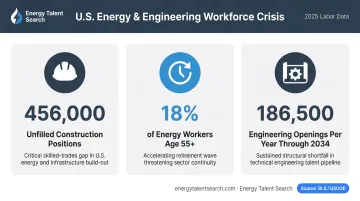
- Deloitte reports 456,000 unfilled U.S. construction positions as of early 2024, with over 80% of executives reporting difficulty filling roles
- 18% of energy workers are aged 55 or older, signaling a wave of retirements that will accelerate vacancy pressure in technical and senior roles
- The BLS projects roughly 186,500 architecture and engineering openings per year through 2034 — many driven by workforce exits, not just new growth
The firms below are the ones energy and engineering employers are turning to when in-house hiring falls short.
Top Recruiting Firms for Energy and Engineering Hiring
These firms were evaluated for sector depth, candidate network quality, engagement model flexibility, geographic reach, and documented service capabilities.
Energy Talent Search
Energy Talent Search is a Denver, Colorado-based boutique recruitment agency with decades of collective experience, placing skilled professionals with employers across traditional oil and gas, renewable and alternative energy, technology, manufacturing, mining, construction, and accounting and finance — from entry-level roles through executive leadership.
What sets Energy Talent Search apart is its commitment to personalized service. Every search begins with a genuine discovery process: the team takes time to understand a client's culture, technical requirements, and long-term hiring goals before presenting a single candidate.
That approach extends to passive candidate sourcing — the firm specifically focuses on headhunting professionals not actively on job boards, including niche talent like offshore wind turbine engineers or upstream drilling specialists who rarely surface through standard channels.

The agency also operates with an unusual degree of transparency: if Energy Talent Search determines it isn't the right fit for a particular search, it refers clients to firms that are — a practice that prioritizes long-term relationships over short-term billing.
| Criteria | Details |
|---|---|
| Specialization | Energy (oil & gas, renewables, mining, construction), technology, manufacturing, accounting & finance |
| Engagement Models | Personalized search tailored per client; entry-level through executive placements |
| Geographic Reach | Denver-based headquarters; serves employers nationwide across the U.S. |
Aerotek
Founded in 1983 and part of Allegis Group, Aerotek serves more than 18,000 clients and 170,000 contractors annually across 160 U.S. office locations. Its current focus covers construction, energy project staffing, skilled trades, quality control, and operations support.
One documented example: Aerotek recruited and managed 370 workers over five months across three remote solar construction sites in Florida and South Carolina — demonstrating genuine capability in field-level energy workforce delivery. For employers needing contract labor or project-based crew staffing at volume, Aerotek has the operational infrastructure to execute.
Note: Aerotek's engineering and sciences division was reorganized into a separate entity (Actalent) in 2021. Companies specifically seeking engineering discipline placement should evaluate whether Aerotek or Actalent better fits their needs.
| Criteria | Details |
|---|---|
| Specialization | Construction and energy project staffing, skilled trades, industrial operations |
| Engagement Models | Temporary, contract, temp-to-hire, and direct hire; managed and project services |
| Geographic Reach | Nationwide U.S. with 160+ office locations |
Hays
Hays is a global staffing firm with approximately 9,100 employees across 198 offices in 30 countries and 14 U.S. office locations including Houston, Dallas, Austin, and Los Angeles. Its U.S. energy practice covers alternative energy and renewables, with verified recruiting across wind, solar, and emerging green technologies.
For employers focused on the renewable energy transition, Hays brings global candidate sourcing capability — an advantage when projects require talent that isn't readily available in local U.S. markets. Discipline-specific strengths worth noting:
- Project management and engineering roles across wind and solar
- Cross-border candidate sourcing for hard-to-fill technical positions
- Permanent recruitment focused on renewable energy scale-up phases
| Criteria | Details |
|---|---|
| Specialization | Alternative energy and renewables (wind, solar, emerging green technologies) |
| Engagement Models | Permanent recruitment and workforce solutions |
| Geographic Reach | 14 U.S. offices; global candidate sourcing capability |
NES Fircroft
NES Fircroft is a global technical and engineering staffing specialist managing more than 25,000 contractors through 80+ worldwide offices. It covers oil and gas, power and renewables, chemicals, and construction and infrastructure — and among the firms on this list, it pairs the broadest sector coverage with the most comprehensive workforce management options.
Beyond individual placements, NES Fircroft provides managed workforce solutions including MSP (Managed Service Provider) programs and RPO (Recruitment Process Outsourcing) — suited for operators running large project teams who need consistent crew staffing rather than one-off hires.
Its North America operations run coast-to-coast, making it a practical option for energy employers with distributed project footprints.
| Criteria | Details |
|---|---|
| Specialization | Oil and gas, power and renewables, chemicals, construction and infrastructure |
| Engagement Models | Contract, direct hire, managed solutions, MSP, and RPO |
| Geographic Reach | Global network with verified U.S. coast-to-coast coverage |
Brunel
With operations across 45 countries, 120+ offices, and more than 12,000 specialists placed, Brunel focuses on technical recruitment for conventional energy, renewable energy, mining, and power. U.S. clients include utilities, developers, independent power producers, OEMs, and EPC contractors.
The firm handles both contract and direct hire placements, with contract services covering full contractor lifecycle management: recruiting, onboarding, managing, and offboarding. For energy companies managing multi-phase capital projects where staffing needs fluctuate, Brunel's project-aligned staffing model is worth evaluating alongside firms that focus on individual permanent placements.
| Criteria | Details |
|---|---|
| Specialization | Conventional energy, renewables, mining, and power generation |
| Engagement Models | Contract hire and direct hire |
| Geographic Reach | International network with U.S. operations across major energy markets |
How to Choose the Right Energy and Engineering Recruiting Firm
The most common mistake companies make is defaulting to the largest or most recognized agency name — only to find that its recruiters lack the technical literacy to screen candidates for certifications, safety credentials, or discipline-specific requirements.
Evaluate firms against these criteria:
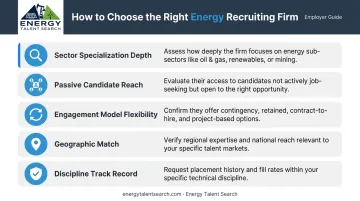
- Confirm sector specialization depth — Can recruiters distinguish between an upstream reservoir engineer and a production engineer? Do they screen for OSHA certifications, well control credentials, or PE licensing?
- Ask about passive candidate reach — What percentage of placements come from candidates not actively on job boards? Hard-to-fill technical roles rarely get solved through job postings alone.
- Engagement model flexibility — Can the firm handle contract staffing for project needs and retained or direct hire for permanent or leadership roles? Not every search is the same.
- Geographic match — Does the firm have demonstrated reach in the specific energy markets where your operations are located?
- Track record in your discipline — General "energy sector experience" claims are not the same as verified placements in upstream oil and gas, offshore wind, or subsea engineering specifically.
Boutique and mid-sized specialized firms frequently outperform large generalist agencies in energy hiring because their recruiters carry domain knowledge that enables faster, more accurate candidate matching. In technical roles, a mis-hire doesn't just cost money — it sets projects back by months. Firms like Energy Talent Search are built around this principle: deep sector focus, passive candidate networks, and flexible engagement models that match how energy companies actually hire.
Conclusion
The right recruiting partner for energy and engineering hiring isn't necessarily the biggest name — it's the firm whose recruiters speak the technical language of your industry, have access to candidates who aren't circulating on job boards, and act as a long-term talent partner invested in your team's success, not just filling a requisition.
Before committing to a firm, ask directly: How many candidates in your network hold the specific credentials this role requires? What's your track record in this discipline? How do you handle a search that falls outside your core expertise? The answers will tell you quickly whether you're talking to a specialist or a generalist with a broad pitch.
For energy, engineering, technology, manufacturing, and accounting and finance hiring — from entry-level to executive — Energy Talent Search specializes in sourcing passive candidates that never surface on job boards, matching on both technical credentials and culture fit. Reach out to the team to start a search.
Frequently Asked Questions
What types of roles do energy and engineering recruiting firms typically fill?
Specialized firms place across the full range — field technicians, project engineers, HSE specialists, reservoir engineers, operations managers, and C-suite leaders. The best firms cover all seniority levels rather than focusing exclusively on executive search or contract labor.
How do specialized energy recruiting firms differ from general staffing agencies?
Specialized firms employ recruiters with energy or engineering industry backgrounds who understand technical credentials, licensing requirements, and sector-specific culture. That knowledge sharpens candidate screening accuracy and shortens time-to-fill. Generalist agencies, by contrast, routinely mismatch hard-to-source technical roles.
How much do energy and engineering recruiting firms charge?
Fees vary by engagement type. Contingency searches are typically a percentage of the placed candidate's first-year salary, while retained searches include upfront components. Contract staffing is billed at a markup on the candidate's hourly rate. Firms outline fee structures during an initial consultation.
How long does it take to fill an energy or engineering role through a recruiting firm?
Timeline depends on role specialization and market availability — common technical roles may fill within weeks, while executive or highly specialized positions take longer. Firms with strong passive candidate networks typically close hard-to-fill roles faster.
What should companies look for when choosing an energy sector recruiting firm?
Prioritize demonstrated sector specialization, recruiter backgrounds in energy or engineering, flexibility in engagement models, transparent pricing, and evidence of successful placements in your specific discipline or geography. Ask for specifics: which disciplines they've placed, in which geographies, and at what seniority levels. Verified technical depth matters far more than broad sector claims.
Can energy recruiting firms help with both contract and permanent placements?
Yes — most specialized energy firms offer both. Contract staffing works well for project-based or time-limited needs; direct hire or retained search is better suited for permanent roles or leadership positions where cultural fit and long-term retention matter most.