Introduction
Energy hiring managers face a compounding problem. The talent pool for technical roles is thinning—according to the IEA's 2025 World Energy Employment report, advanced economies now have 2.4 energy workers nearing retirement for every worker under 25. Meanwhile, candidates for specialized roles in oil and gas, renewables, and mining are rarely active job seekers, and your next hire is almost certainly working for someone else right now.
Purely in-person recruiting can't reach dispersed candidates fast enough. Fully virtual processes miss the interpersonal depth that high-stakes field and executive roles demand. Hybrid recruiting offers a third path: a deliberate blend of virtual and in-person methods built for the realities of energy hiring. This guide explains what it actually looks like, why it fits the sector, and when to question whether it's the right model for your search.
Key Takeaways
- Hybrid recruiting pairs digital sourcing and virtual screening with selective in-person assessment at final stages
- Energy's aging workforce and dual-sector demand across oil and gas and renewables make speed and geographic reach critical
- The process runs in three stages: digital sourcing → virtual screening → in-person final assessment
- Role type and seniority determine how much weight each stage carries
- Poor candidate experience between stages is the most common reason the model fails
What Is Hybrid Recruiting?
Hybrid recruiting is a talent acquisition strategy that integrates virtual methods—online sourcing, video interviews, AI-assisted screening—with in-person methods such as site visits, hands-on assessments, and face-to-face final interviews, all within a single coordinated hiring process.
The key word is coordinated. Hybrid recruiting isn't a loose combination of whatever happens to be convenient. It's a deliberate decision about which stages benefit from digital efficiency and which require human, in-person judgment.
How It Differs from Fully Remote Recruiting
The distinction matters in energy more than most sectors:
- Fully virtual recruiting works best for speed and scale: high-volume, clearly defined roles where qualifications are straightforward to verify digitally
- Fully in-person recruiting prioritizes depth, but at a cost. Geographic reach shrinks, and time-to-hire stretches considerably
- Hybrid recruiting sequences both, using virtual stages to filter and engage broadly, then deploying in-person touchpoints selectively for shortlisted candidates where in-person judgment adds real value
For a drilling engineer based in Midland, a reservoir specialist in Calgary, or a wind energy project manager in rural Texas, the in-person-first model simply doesn't work at scale.
Why Hybrid Recruiting Is Essential for Energy Hiring Managers
The energy sector's talent challenges aren't generic. They're structural, and they've been building for years.
The Scale of the Problem
The numbers tell a clear story:
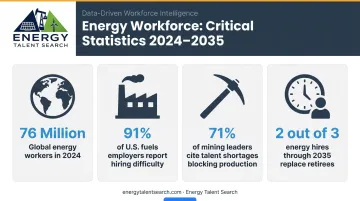
- Global energy employment reached 76 million workers in 2024, growing at nearly twice the rate of the broader economy—but the IEA reports that skills shortages are now threatening to stall that momentum
- In the U.S., 91% of manufacturing employers in the fuels sector reported difficulty hiring, with 50% citing insufficient certifications or education as the primary barrier
- McKinsey found that 71% of mining leaders say talent shortages are preventing them from meeting production targets
- Two-thirds of all energy hires needed through 2035 will replace retirees—before accounting for growth
The dual-sector reality compounds this pressure. Since 2019:
- Oil and gas has recovered most of its pandemic-era losses
- Solar PV generated half of all electricity-sector job additions
- EV and battery employment grew by nearly 800,000 positions in 2024 alone
Energy hiring managers are now competing against both transition-energy and conventional-energy employers for the same shrinking pool of experienced candidates.
Why Passive Candidate Reach Is Non-Negotiable
The most qualified engineers, project managers, and technical specialists in these sectors are already employed. They're not refreshing job boards. Reaching them requires proactive digital outreach before any in-person engagement is warranted.
Energy Talent Search, for instance, builds pre-qualified talent pipelines specifically for hard-to-fill technical roles across oil and gas, renewables, and mining—targeting candidates who aren't actively looking but are open to the right opportunity. Digital outreach is what surfaces those candidates in the first place—long before a site visit or in-person interview is on the table.
What Happens Without a Hybrid Approach
Without both channels working together, hiring managers pay a real cost on one side or the other:
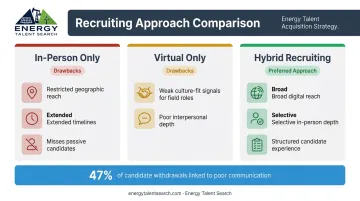
- In-person-only recruiting restricts geographic reach, extends timelines, and often misses the passive candidates who represent the best hires
- Virtual-only recruiting risks poor culture-fit decisions for field operations and leadership roles that depend heavily on interpersonal dynamics and physical environment judgment
- No structured process at all creates candidate experience gaps—Monster's research found that 47% of candidate withdrawals are linked to poor communication, and 36% to excessive or unclear process hurdles
A 2021 Jobvite survey found 61% of recruiters already expected blended virtual/in-person hiring to become standard. In energy, that expectation has since become table stakes.
How Hybrid Recruiting Works in the Energy Sector
The end-to-end hybrid process moves from broad digital reach to selective in-person depth. Role type, seniority, and urgency all affect how the stages are weighted, so treat this as a flexible framework rather than a fixed checklist.
Stage 1: Digital Sourcing and Candidate Identification
This stage is where most in-house teams underinvest. Active job postings alone are insufficient for niche energy roles—they only reach active job seekers, who represent a fraction of the qualified candidate market.
Effective digital sourcing in energy includes:
- Posting on specialized platforms (Rigzone, LinkedIn Energy groups, sector-specific job boards)
- Direct outreach to passive candidates through professional networks
- Recruiter networks with existing relationships in relevant disciplines
- Proactive pipeline development for roles that recur or are difficult to fill
The goal at this stage isn't just applications—it's identifying the right people whether or not they've raised their hands.
Stage 2: Virtual Screening and Initial Interviews
Once candidates are identified, virtual tools do the filtering work efficiently:
- Screen for non-negotiables with AI-assisted ATS tools: certifications, years of domain experience, regulatory compliance knowledge
- Run structured video interviews to assess communication, motivation, and preliminary culture fit without requiring travel
- Use digital technical assessments to verify knowledge-based competencies (regulatory frameworks, project management methodology, technical concepts)
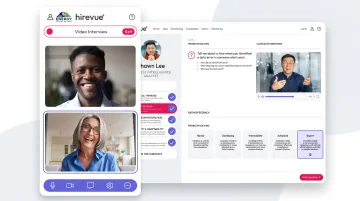
Companies like BHP use platforms such as HireVue for online video and gamified assessments at this stage. Shell uses self-recorded video interviews for early candidate evaluation. The logic is straightforward: maximize candidate reach digitally, then protect in-person time for decisions that actually require it.
One critical boundary: video interviews verify knowledge, not field competence. Per the IADC's competence assessment standards, direct observation remains the primary method for validating practical technical skills. Don't treat a strong video interview as proof of hands-on capability.
That gap between verified knowledge and demonstrated competence is exactly what Stage 3 is designed to close.
Stage 3: In-Person Assessment and Final Selection
In-person engagement at this stage serves specific, high-value purposes—not routine evaluation:
- Site tours or operations briefings help candidates assess whether the physical environment matches their expectations, and let you evaluate how they engage with it
- Team lead meetings surface interpersonal dynamics that video calls routinely miss
- Senior candidate closing — experienced professionals at the executive or principal level often need the signal of face-to-face attention before committing to a move
This stage is reserved for shortlisted candidates only. Every in-person touchpoint should have a clear purpose tied to the hire decision.
Key Factors That Shape Hybrid Recruiting in Energy
The hybrid model isn't universal—these factors determine how you weight each stage:
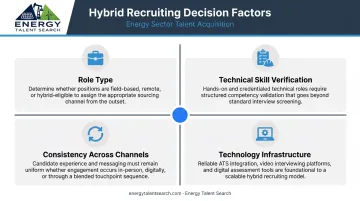
Role type. Finance, technology, and administrative roles can often complete 90% of the process virtually. Field operations, engineering, and executive roles need more in-person weight at later stages.
Technical skill verification. Safety certifications, equipment familiarity, and hands-on compliance knowledge can't be confirmed on a video call alone. Decide upfront whether a structured technical screen, a case exercise, or an in-person demonstration is required—and build it in before it becomes a late-stage surprise.
Consistency across channels. Gaps in communication or inconsistent processes between virtual and in-person stages cause drop-off. In a market where qualified candidates have options, a disorganized process sends them elsewhere.
Technology infrastructure. Video conferencing, ATS integration, and digital assessment tools need to be in place before the search begins. Retrofitting them mid-process disrupts the candidate experience and delays decisions.
Common Misconceptions About Hybrid Recruiting in Energy
Energy hiring managers run into the same process traps repeatedly. Most stem from three misconceptions worth addressing directly.
Misconception 1: Hybrid Recruiting Just Means Some Interviews Are Virtual
It actually requires a deliberate decision about which stage uses which modality and why—tied to the specific role and candidate profile. Without that intentionality, you're not running a hybrid process. You're running an inconsistent one.
Misconception 2: Hybrid Recruiting and Hybrid Work Are the Same Decision
These are separate questions. Hiring managers often conflate whether a role will be worked hybrid with whether the recruiting process should be hybrid. A fully remote renewable energy project manager can still benefit from an in-person final interview. A field-based engineer hired through an entirely virtual process may not.
Misconception 3: Virtual Screening Is Always the Right First Filter
Using video interviews as a one-size-fits-all opener—regardless of role complexity—then adding multiple unnecessary in-person rounds signals poor process design. It wastes candidate time, reflects disorganization, and increases withdrawal risk at exactly the stages where you've already invested the most.
When Hybrid Recruiting May Not Be the Right Approach
Two scenarios where hybrid recruiting adds friction rather than value:
High-volume, entry-level field roles — When qualification criteria are standardized, volume is high, and cultural complexity is low, a fully virtual process moves faster. The extra coordination of an in-person stage slows you down without adding proportional accuracy.
Highly confidential senior executive searches — When relationship sensitivity and discretion are paramount, a concierge, in-person-led approach from the start often fits better than a structured digital-first funnel.
Outside these two extremes, hybrid works well — but only when each stage has a clear purpose. If yours has drifted into habit rather than strategy, these signals will tell you.
Signs You're Running Hybrid by Default, Not by Design
Watch for these signals:
- Hiring managers can't explain why a specific stage is virtual versus in-person
- Candidate drop-off is high between stages, particularly mid-funnel
- Time-to-hire hasn't improved despite adding virtual screening
- In-person rounds feel repetitive rather than progressively deeper
If any of these are present, the fix is redesigning the process around what each stage is actually supposed to accomplish — not adding more steps to it.
Conclusion
Hybrid recruiting is a framework for making better hiring decisions faster. For energy hiring managers navigating a shrinking technical talent pool, geographically dispersed worksites, and simultaneous demand across conventional and renewable sectors, it's a practical tool for accessing broader candidate pools while preserving the human judgment that high-stakes roles require.
The difference between hybrid recruiting that works and hybrid recruiting that frustrates is design intentionality. The companies seeing results are those that map each stage to specific role types, seniority levels, and candidate profiles—rather than applying the same process to every search regardless of context.
Energy Talent Search works with energy companies to build and execute exactly that kind of structured, role-specific process—from passive candidate identification through final placement—across oil and gas, renewables, mining, and adjacent sectors. If your current process isn't producing the results you need, reach out to discuss what a redesigned approach could look like for your team.
Frequently Asked Questions
What is hybrid recruiting?
Hybrid recruiting is a talent acquisition strategy that combines virtual methods—video interviews, digital screening, online sourcing—with in-person touchpoints at strategic stages. It uses the efficiency of digital tools for early-stage reach and the depth of face-to-face interaction where it genuinely affects the hiring decision.
Which of the following is an example of a hybrid recruiting approach?
A practical example: conducting initial screening and first-round interviews via video to evaluate qualifications and communication, then inviting only finalists to an on-site interview or facility tour before extending an offer. The virtual stage widens your reach; the in-person stage confirms your decision.
What is the 70/30 rule in hiring?
The 70/30 concept typically weights 70% on technical skills and 30% on cultural or behavioral fit. It's not a formal methodology, but it's a practical guide for hybrid stage design: use virtual tools for technical screening, and reserve in-person time for culture and interpersonal assessment.
How does hybrid recruiting work for field-based or remote-site energy roles?
For roles at drilling sites, wind farms, or offshore platforms, virtual stages handle initial qualification and credential screening. In-person elements such as regional office meetings or controlled site visits then assess physical readiness, safety culture alignment, and team fit before an offer is extended.
What tools are needed to run an effective hybrid recruiting process in the energy sector?
The core stack includes an applicant tracking system (ATS), reliable video conferencing, structured digital assessment tools, and access to a sourcing platform or recruiter network capable of reaching passive candidates in niche energy disciplines. All of these need to be functional before the search begins.
When should an energy company use fully virtual recruiting instead of hybrid?
Fully virtual works best for high-volume, clearly defined entry-level or administrative roles where qualification criteria are straightforward. Hybrid recruiting delivers the most value for specialized, senior, or culturally complex positions where in-person judgment materially affects whether you make the right hire.