

That's why most energy companies eventually turn to executive search firms. But recruiting fees in this sector aren't straightforward, and misunderstanding them upfront creates real problems: blown budgets, mismatched search partners, and senior roles that sit vacant for months.
This guide breaks down typical fee ranges, the three primary search models, what drives costs up in energy specifically, and the hidden expenses employers routinely overlook.
Key Takeaways
- Executive recruiting fees typically range from 20%–33% of first-year total cash compensation, depending on the model
- Retained search commands higher fees but delivers exclusive focus and access to passive candidates — the right fit for most C-suite energy searches
- Retirement waves, the energy transition, and geographic talent concentration all compress candidate pools and raise search complexity
- The true cost of a wrong executive hire far exceeds any recruiter's fee
- Always request written disclosure of what's included and what's billed separately before signing
How Much Do Executive Recruiting Fees Cost?
There's no fixed price for executive search. Fees vary based on the model chosen, role seniority, how hard the candidate is to find, and the recruiter's depth in your sector. Employers who skip this homework tend to pay for it twice — once by choosing the wrong search model for the role, and again when add-on costs appear that weren't in the quoted percentage.
Here's how the numbers actually break down.
Typical Fee Ranges by Model
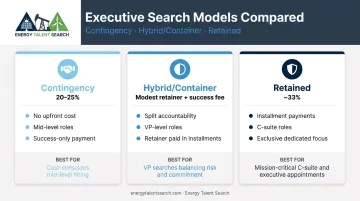
| Model | Fee Range | Payment Trigger |
|---|---|---|
| Contingency | 20%–25% of first-year cash compensation | Paid only upon successful placement |
| Retained | ~33% of first-year total cash compensation | Billed in installments, regardless of outcome |
| Hybrid/Container | Modest upfront retainer + success fee | Split between engagement start and placement |
Source: SHRM's guidance on working with executive search firms
What These Numbers Look Like in Practice
For context, here's what retained search fees translate to at compensation levels common in energy leadership:
| Annual Compensation | At 25% | At 30% | At 33% |
|---|---|---|---|
| $180,000 | $45,000 | $54,000 | $59,400 |
| $275,000 | $68,750 | $82,500 | $90,750 |
| $400,000 | $100,000 | $120,000 | $132,000 |
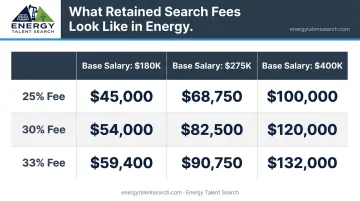
A VP of Engineering at $275,000 in total cash compensation could generate a retained search fee of $82,500–$90,750. That figure covers the search itself — but not everything that comes with it.
What's Typically Included
Standard fees generally cover:
- Sourcing passive and active candidates through direct outreach
- Screening and qualifying candidates against role requirements
- Presenting a shortlist with written summaries for each candidate
- Coordinating interview scheduling and logistics
- Providing compensation benchmarking data to inform offer decisions
What's Usually Billed Separately
Expect potential add-on costs for:
- Candidate travel and accommodation for in-person interviews
- Psychometric or technical assessments
- Background check and reference verification services
- Relocation coordination support
The AESC's Client Bill of Rights requires that written engagement agreements disclose fees, payment schedules, deliverables, guarantees, and off-limits restrictions. Request this documentation before signing anything.
The Three Executive Search Fee Models Explained
The model you choose shapes more than the price — it determines the recruiter's incentives, how much dedicated attention your search receives, and ultimately the quality of candidates you see.
Retained Executive Search
In a retained engagement, the employer pays fees upfront in installments — typically split across three milestones: engagement launch, shortlist delivery, and offer acceptance. The recruiter works exclusively on the assignment and is paid whether or not a hire is ultimately made.
This model suits senior energy roles precisely because of what it buys: dedicated focus, deep passive candidate outreach, and thorough cultural and technical vetting. These candidates are fully employed, performing well, and not browsing job boards.
Roles that typically require this approach include:
- VP of Operations
- Chief Financial Officer
- Head of HSE
- Chief Sustainability Officer
Best for: C-suite and senior director roles where passive candidate access and exhaustive vetting are non-negotiable.
Contingency Search
Contingency recruiters are paid only when a candidate is successfully placed. Fees only apply when a placement is made. That appeals to budget-conscious employers, but it creates a structural problem for senior searches.
As AESC notes, contingency recruiters are nonexclusive, typically perform the front end of the process, and leave detailed assessment and selection to the client. When an assignment gains no traction, a contingency recruiter has little incentive to continue working it.
For mid-level energy roles — project engineers, accounting managers, field supervisors — contingency works well. Candidate pools are wider, turnaround matters more than exhaustive vetting, and the speed-focused model fits.
Best for: Mid-level roles with broader candidate pools where speed is the priority.
Hybrid/Container Search
The hybrid model sits between the two: a modest upfront retainer combined with a success fee upon placement. It secures more dedicated attention than pure contingency without the full financial commitment of a retained engagement.
This structure works well for VP-level roles, newly created leadership positions, or searches in emerging energy subsectors — battery storage, carbon capture, offshore wind — where candidate pools are specialized but not as narrow as true C-suite. The upfront component gives the recruiter incentive to invest real effort; the success fee keeps them accountable for results.
Best for: VP-level and specialist roles that need dedicated attention but don't justify full retained economics.
Key Factors That Drive Recruiting Fees in the Energy Sector
Energy executive search is shaped by dynamics that don't exist in most other industries. Understanding them explains why fees vary so significantly — and why the cheapest option often isn't the most cost-effective one.
Role Seniority and Specialization
The more senior and technically specific the role, the more complex and costly the search. A VP of Reservoir Engineering with 20+ years of offshore experience is a fundamentally different search than a Finance Director. Specialization within energy subsectors compounds this further — offshore drilling expertise doesn't transfer to utility-scale solar, and carbon capture leadership is an entirely different talent market than pipeline operations.
Highly specialized roles shrink the addressable candidate pool and require deeper, more time-intensive outreach — both factors that push fees toward the upper end of any range.
Energy Market Conditions and Talent Scarcity
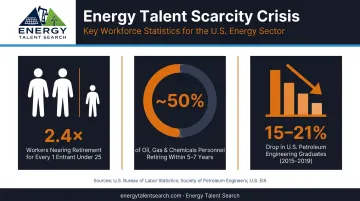
The supply-demand imbalance in energy talent is well-documented. According to the IEA's 2024 World Energy Employment report, global energy employment reached 76 million in 2024 — up 2.2% — yet more than half of 700 surveyed organizations reported critical hiring bottlenecks. The pipeline pressure is structural:
- 2.4 energy workers nearing retirement for every entrant under age 25 in advanced economies (IEA)
- Nearly 50% of oil, gas, and chemicals personnel expected to retire within five to seven years (Deloitte)
- U.S. petroleum and geological engineering graduates fell 15%–21% between 2015 and 2019
Commodity price cycles intensify this further. When oil prices rise, hiring surges and competition for experienced executives tightens. That compression in available passive candidates drives search complexity — and cost — upward.
Geographic and Hub-Based Factors
Talent concentration in energy is extreme. BLS data from May 2023 shows 5,850 petroleum engineers in Houston (location quotient: 13.71), 1,160 in Midland (location quotient: 75.24), and 750 in Denver (location quotient: 3.51).
This concentration shapes search strategy. Searches in major hubs require broad passive candidate outreach within a dense but competitive talent pool. Searches outside those hubs — offshore wind in the Northeast, for example — require identifying candidates willing to relocate, which adds outreach scope and sometimes direct costs.
Boutique vs. Generalist Recruiter
A generalist executive search firm may charge a competitive fee but arrive at your search without existing relationships in the energy sector. They'll spend weeks building context that a specialist already has — time that directly extends your hiring timeline.
Energy-focused boutique firms like Energy Talent Search operate with networks already embedded in the sector, spanning oil and gas, renewables, mining, and adjacent technical disciplines. That existing infrastructure typically means faster candidate identification, stronger shortlists, and less time searching without sector context. Boutique fees are often competitive with generalist retained firms, while delivering sharper candidate-fit precision.
What Energy Employers Often Miss When Evaluating Recruiting Fees
Comparing Percentages Without Comparing Models
A 20% contingency fee and a 30% retained fee look very different on paper. They are very different in practice. The contingency recruiter has no financial incentive to keep working your search if it gets difficult. The retained recruiter is exclusively committed to it.
For senior energy roles, the lower-percentage contingency option often delivers slower results, fewer passive candidates, and less thorough vetting. The "savings" erode quickly when the search stretches from 60 days to six months.
Underestimating the Cost of a Wrong Hire
The recruiter's fee is a fraction of what a failed executive hire costs. A search restart means:
- Lost productivity during the vacancy period
- Team disruption from leadership instability
- A full restart of the search at full cost
- Organizational momentum stalled while the seat sits empty
For C-suite and VP-level roles in energy — where decisions shape capital allocation, safety performance, and long-term project outcomes — that cost compounds quickly. Retained search fees reflect the cost of getting the hire right the first time.

Choosing Cheapest Without Evaluating Fit
A generalist firm charging less but lacking energy sector networks will surface fewer qualified passive candidates. The search takes longer, the shortlist is thinner, and the employer often settles. The indirect cost — extended vacancy, opportunity cost, and a potential bad hire — exceeds the premium a specialist would have charged.
Before evaluating price, evaluate sector depth:
- How many energy executives has this firm placed?
- Which subsectors do they cover — upstream, midstream, renewables, mining?
- Can they name specific companies they've worked with?
Frequently Asked Questions
How much does an executive recruiter charge?
Executive recruiting fees typically range from 20%–25% for contingency search and approximately 33% for retained search, calculated on first-year total cash compensation. Energy sector specialization and role seniority tend to push fees toward the upper end of those ranges.
Is an executive recruiter worth it?
For senior energy roles, specialized recruiters typically deliver strong value: the candidate pool is narrow, passive candidates rarely respond to job postings, and a bad hire costs far more than the fee. Most employers find the investment justified when weighed against the cost of a failed or prolonged search.
What roles in the energy sector typically require executive search?
Common roles filled through executive search include CEO, VP of Operations, VP of Engineering, Chief Financial Officer, Director of HSE, Head of Business Development, Chief Sustainability Officer, and similar senior leadership positions across traditional and renewable energy.
Should energy companies use retained or contingency search?
Use retained search for C-suite and senior director roles requiring passive candidate access and dedicated effort. Contingency search fits mid-level roles — project engineers, operations managers, field supervisors — where candidate pools are broader and speed drives value.
How long does an energy sector executive search typically take?
A retained executive search typically runs 60–120 days from engagement to offer acceptance, depending on role complexity, candidate availability, and interview pace. Roles in emerging subsectors or requiring relocation tend to extend that timeline.
What should energy employers ask a recruiting firm before signing an engagement?
Three questions matter most: (1) What specific experience do you have placing executives in our energy subsector? (2) Which companies in our space are currently off-limits to you? (3) What is included in the fee, and what will be billed separately?