Introduction
Energy hiring has never been straightforward. Technical roles are getting harder to fill, the energy transition is creating demand for skill sets that barely existed five years ago, and the professionals best suited for these positions — reservoir engineers, HSE directors, renewable project developers — are typically employed, not actively job-searching.
The consequences of getting this wrong are real. A delayed hire on a safety-critical role can halt field operations. A misaligned placement on a project management position can derail timelines worth millions.
According to the IEA's 2025 World Energy Employment report, demand for applied technical workers grew 16% from 2015 to 2022 while relevant program graduations rose just 9% — a gap that's only widening.
That supply-demand imbalance is exactly why the recruiting model an energy firm chooses carries real operational weight — not just administrative preference.
This guide breaks down both models honestly — cost structures, candidate access, speed, and where each approach genuinely wins — so your leadership team can make the right call for your specific situation.
Key Takeaways
- In-house recruiting works best for high-volume, predictable hiring at companies with strong employer brand recognition.
- Agency recruiting has a structural advantage for specialized, senior, or urgent energy roles where passive candidate access matters most.
- Most skilled energy professionals are not actively job hunting — passive candidate reach is the deciding factor for niche technical roles.
- Agency fees (typically 20–25% of first-year salary) are often more cost-effective than maintaining year-round internal recruiting overhead for cyclical hirers.
- A hybrid model — lean internal team for volume roles, specialized agency for technical and leadership hires — is where most mid-to-large energy firms settle.
In-House vs. Agency Recruiting: Quick Comparison
| Factor | In-House Recruiting | Agency Recruiting |
|---|---|---|
| Cost Structure | Fixed overhead year-round (salary, benefits, tools) | Variable, per-placement fee (typically 20–25% of salary) |
| Time-to-Fill | Longer for niche roles; dependent on inbound applicants | Faster for specialized roles via existing candidate pipelines |
| Candidate Network Access | Limited to job board applicants and internal referrals | Established networks including passive candidates |
| Cultural Fit Capability | Strong — internal teams know the company deeply | Requires thorough briefing; good agencies bridge this well |
| Flexibility for Cyclical Demand | Poor — fixed cost during downturns | Strong — engage only when needed |
| Energy Sector Specialization | Varies widely; depends on individual recruiter background | High with a specialized energy agency |
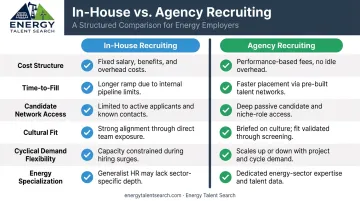
Most energy firms find in-house recruiting strains hardest during commodity-driven hiring surges, while agency recruiting shows its limits when cultural alignment is non-negotiable. The sections below break down exactly when each model earns its keep.
In-House Recruiting for Energy Firms
What It Is and Where It Works
An in-house recruiter — or internal talent acquisition team — is a salaried employee managing the full hiring lifecycle for your company exclusively. From writing job descriptions to extending offers, they own the process end to end.
For larger energy firms with predictable, ongoing staffing needs, this model delivers genuine value. A utility company hiring field technicians quarterly, or an integrated energy company constantly onboarding engineering graduates, can build real momentum with a dedicated internal function.
The clearest advantage is institutional knowledge. Internal recruiters develop a deep understanding of your operational culture, your safety standards, and the nuanced differences that actually matter to hiring managers.
That fluency shows up in practice — knowing that a candidate with downstream refining experience is a fundamentally different profile than someone from upstream exploration, even if both have "petroleum engineer" on their resume. It takes time to build, and an external party can't replicate it without significant onboarding.
The Real Cost of an Internal Recruiter
Building an in-house function isn't cheap. According to BLS data, HR specialists in US oil and gas extraction earn a mean annual wage of $104,840. Add standard benefits — BLS reports private-industry employers pay an average of $14.01 per hour in benefits — plus an applicant tracking system, job board subscriptions, sourcing tools, and background check vendors, and the all-in annual cost of maintaining one internal recruiter runs considerably higher than the base salary alone.
That's a fixed cost your company carries regardless of whether hiring is active or slow.
Where In-House Teams Hit a Wall in Energy
For in-house teams in energy, the core problem isn't process — it's access. The best candidates aren't applying.
Energy Talent Search's recruitment model is built explicitly around headhunting passive candidates for niche engineering and technical roles — "heavily," in their own words — because waiting for applications is insufficient for specialized energy disciplines. Geoscientists, drilling engineers, and renewable project developers who are good at their jobs typically aren't updating their resumes. They're working.
Internal recruiters without established networks in these talent pockets face a predictable outcome: longer time-to-fill and higher reliance on whoever happens to apply rather than who's actually best for the role.
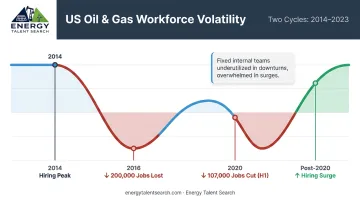
Cyclical demand compounds this problem. The US oil and gas industry shed roughly 200,000 jobs during the 2014–2016 downturn and eliminated another 107,000 in the first half of 2020 alone, according to Deloitte's analysis of the sector's workforce volatility.
During those contractions, a full-time internal recruiter represents a fixed cost with nothing to do. During the subsequent hiring surges, they're overwhelmed. The economics rarely balance out for companies that don't hire continuously.
When In-House Is the Right Call
In-house recruiting is most effective for:
- Large utilities or integrated energy companies with consistent, year-round hiring volume
- Roles where inbound applicant flow is strong — field technicians, admin, financial staff, engineering graduates from known university pipelines
- Companies with a well-established employer brand in their local energy market, where candidates actively seek them out
Agency Recruiting for Energy Firms
The Passive Candidate Advantage
A specialized energy recruitment agency sources, screens, and presents candidates on your behalf — typically on contingency (a percentage of the placed candidate's first-year salary) or retainer for senior executive searches.
The key word in that definition is "specialized." A general staffing firm doesn't know the difference between a completions engineer and a facilities engineer. A specialized energy agency does — and knows where those professionals are and how to reach them.
This matters because the energy talent market is overwhelmingly passive. Gallup's 2024 research found that 52% of US employees were watching for or actively seeking new employment — but in senior technical energy roles, the proportion not actively looking runs considerably higher. These are professionals with specialized credentials, strong current compensation, and little reason to broadcast availability.
Experienced energy agencies have cultivated direct relationships with these individuals over years. In-house teams relying on job boards simply don't reach them.
Energy Talent Search's sourcing model reflects this reality: the agency focuses heavily on headhunting passive candidates across oil & gas, solar, wind, mining, and energy technology , reaching professionals who would never surface through a standard posting.
Speed When It Counts
For energy firms dealing with a contract award, an unexpected vacancy in a safety-critical HSE role, or urgent project staffing after a drilling decision, time-to-fill has direct operational consequences. Field operations can be required to slow or halt without mandatory safety personnel in place. Project timelines slip.
Agencies can move faster because they maintain pre-vetted candidate pipelines. Rather than starting from scratch, they cross-match qualified candidates against a role brief often within hours of receiving it. They also handle compliance documentation and credential verification in parallel, cutting administrative delays between offer and deployment.
Agency recruiters also have a direct financial stake in closing roles quickly — slow searches don't get paid.
Honest Assessment of Agency Costs
SHRM guidance confirms that contingency recruiters typically receive 20–25% of first-year cash compensation, with retained executive search fees running closer to one-third of annual salary and bonus. For highly specialized or senior roles in energy, those numbers reflect the difficulty and scarcity involved in senior-level energy searches.
Compared to the all-in annual cost of an internal recruiter (salary, benefits, tools, and year-round overhead) the per-hire model is frequently more cost-effective for companies that don't hire at high volume continuously. You pay when a placement is made, not when the market is quiet.
The Energy Transition Dimension
As energy companies simultaneously manage traditional operations and build out renewable portfolios, the sourcing challenge gets more complex. Recruiters need to understand both talent pools , and those pools don't overlap much.
Energy Talent Search's parallel service lines across oil & gas and renewable energy (solar, wind, and alternative energy) allow it to source across both markets within a single engagement. For an oil & gas client moving into solar development, the agency can identify professionals with transferable project management or engineering skills from the conventional side while simultaneously sourcing specialists from the renewable talent market.
A generalist internal team, or even an internal recruiter with oil & gas background only, typically can't bridge that gap.
When Agency Recruiting Is the Right Call
Agency recruiting is most effective for:
- Senior technical roles: reservoir engineers, wind farm project managers, HSE directors, drilling supervisors
- Niche positions requiring specific certifications or rare domain expertise
- Urgent placements where operational continuity is at risk
- Cyclical hiring surges that would overwhelm or underutilize a fixed internal team
- Companies entering new energy sub-sectors where internal networks don't yet exist
Which Approach Is Right for Your Energy Company?
Four factors drive this decision:
- Hiring frequency and volume — Do you hire continuously, or in cycles?
- Role complexity — Are you filling standardized positions or highly specialized technical roles?
- Passive candidate dependency — Does the best talent actively apply, or do they need to be found?
- Budget structure preference — Do you prefer predictable fixed costs or variable per-hire fees?
Clear Decision Framework
Choose in-house if:
- Your company hires at consistent, high volume year-round
- You have strong employer brand recognition in your energy market and candidates seek you out
- The bulk of your open roles are standardized — field operations, finance, administration, entry-level engineering
Choose agency if:
- You're filling senior technical or leadership positions where passive candidate access is critical
- Speed matters and operational continuity is at stake
- Your hiring is cyclical and a fixed internal headcount doesn't make economic sense
- You're expanding into a new energy sub-sector where your internal team lacks existing relationships
Consider a hybrid model if:
- You're a mid-to-large energy firm with both high-volume entry-level needs and specialized technical or executive searches
- Your internal TA function can handle employer branding, onboarding coordination, and predictable volume hiring
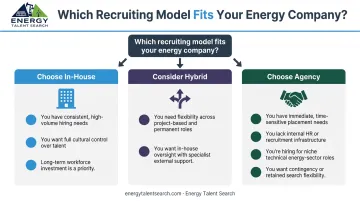
Most experienced energy companies land here: a lean internal team manages high-volume, standardized hiring while a specialized agency takes on technical, leadership, and passive-candidate-heavy searches.
If you're weighing whether agency recruiting could cover what your internal team can't, Energy Talent Search offers a personalized consultation to assess fit. They also maintain a transparent referral policy — if they're not the right match for your specific situation, they'll point you toward an agency that is. Reach the team at energytalentsearch.com or by calling (720) 260-4250.
Frequently Asked Questions
What does "in-house recruiter" mean?
An in-house recruiter is a salaried employee of your company who manages hiring exclusively for your organization — from writing job descriptions to extending offers. Unlike an agency recruiter, they work for one employer, not multiple clients.
How do in-house recruiters get paid?
In-house recruiters receive a flat annual salary plus standard employee benefits. Some roles include performance bonuses tied to hiring goals or time-to-fill targets. They don't earn commissions per placement the way agency recruiters typically do.
What is the 70/30 rule in hiring?
The 70/30 rule holds that most workers are passive — not actively job hunting — while a smaller share is actively searching. In energy, that split matters: most top technical talent won't appear on job boards, which is why agencies with established passive candidate networks carry real weight for specialized roles.
When should an energy company use a recruiting agency instead of hiring in-house?
The clearest scenarios: filling senior or niche technical roles, staffing urgent safety-critical positions, managing cyclical hiring surges, or entering a new energy sub-sector where your internal team has no existing candidate pipeline.
How much does a recruiting agency typically charge for energy sector hires?
Contingency-based agencies typically charge 20–25% of the placed candidate's first-year salary, per SHRM guidance. Executive or retained searches can run closer to one-third of total compensation. For highly technical or safety-critical energy roles, that complexity — not just the title — drives the final fee.
Can an energy company use both in-house and agency recruiting at the same time?
Yes — and many do. A hybrid model, where an internal team handles volume and entry-level hiring while a specialized agency manages technical and leadership searches, is a workable structure for mid-to-large energy firms that need both scale and specialist reach.