Introduction
Drilling engineers, renewable project managers, geotechnical specialists, safety supervisors — these roles share one frustrating trait: they can sit vacant for months despite genuine employer urgency. The problem isn't a shortage of qualified professionals. It's that those professionals aren't on job boards.
According to the IEA, more than half of the 700 energy companies, unions, and education institutions surveyed globally reported critical hiring bottlenecks — and the gap is projected to widen without significant intervention. Standard posting-and-waiting strategies don't reach the candidates energy employers actually need.
That's what this guide addresses — why energy hiring is uniquely resistant to conventional methods, and what a specialized sourcing partner actually does differently.
This guide covers three things:
- Why energy roles are uniquely resistant to conventional hiring methods
- What separates a specialized energy sourcing service from a generalist recruiter
- What to evaluate when choosing a sourcing partner for hard-to-fill positions
Key Takeaways
- Hard-to-fill energy roles require proactive sourcing — passive professionals must be identified and approached directly
- Generalist sourcing falls short against aging workforce pressures, dual-market expertise demands, remote locations, and strict certifications
- Prioritize sector depth, passive candidate methodology, and cultural fit over database size
- A specialized sourcing partner reduces time-to-fill and hiring risk by matching technical qualifications with operational fit
Why Energy Roles Are Uniquely Difficult to Fill
The Workforce Is Aging Out Faster Than It's Replenishing
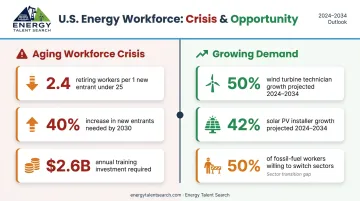
The IEA's 2025 analysis found 2.4 energy workers nearing retirement for every entrant under age 25 in advanced economies. To simply prevent the skills gap from widening, qualified new entrants must increase 40% by 2030 — a gap the IEA estimates requires an additional $2.6 billion annually in education and training investment.
The pipeline isn't keeping pace. And the roles most affected — experienced field engineers, drilling supervisors, refinery process specialists — take years to develop, not months.
Dual-Market Expertise Is Rare
Energy employers now need professionals who understand both traditional operations and emerging technologies. The BLS projects employment growth of 50% for wind turbine technicians and 42% for solar PV installers from 2024 to 2034. Demand for these roles is real — but the crossover talent who can bridge conventional and renewable environments is scarce.
IRENA identifies engineering, quality assurance, maintenance, and project management as transferable skills across the energy transition — yet transferability isn't automatic. 50% of fossil-fuel workers surveyed said they would not consider switching to another energy sector, which means the already-fragmented candidate pool shrinks further when employers need true dual-market fluency.
Geography and Certifications Narrow the Pool Further
Two additional filters eliminate candidates who might otherwise qualify:
Geographic constraints:
- Remote field locations and demanding shift structures (14/14, 21/7) rule out most candidates
- Specific energy corridors — Permian Basin, Bakken, Gulf Coast offshore — require candidates willing to relocate or commute
- Renewable project sites often face the same logistical barriers as traditional field operations
Certification requirements:
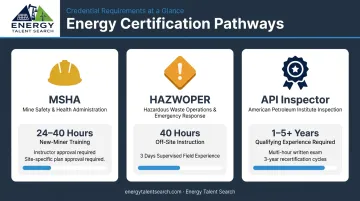
- MSHA mandates 24 to 40 hours of new-miner training depending on mine type, with instructor and plan approval required
- HAZWOPER-covered roles require 40 hours of off-site instruction plus three days of supervised field experience
- API inspector credentials (570, 653) require one to five or more years of qualifying experience, a multi-hour examination, and three-year recertification cycles
These aren't obstacles that keyword filters on a job board can account for. They require a sourcer who already knows which candidates hold which credentials.
Most Qualified Candidates Aren't Searching
The DOE's 2025 USEER found 76% of U.S. energy employers reported at least some difficulty hiring in 2024. That figure climbs to 91% among fuels manufacturers and 89% among transmission, distribution, and storage construction employers. The most cited reason: qualified candidates simply aren't in the applicant pool.
Experienced energy professionals with 10-plus years in technical or leadership roles are typically employed, not browsing job listings. Reaching them means proactive outreach into active professional networks — not posting and waiting.
What Is Candidate Sourcing for Energy Companies?
Candidate sourcing is the proactive process of identifying and engaging qualified professionals before a formal application takes place. It contrasts with reactive hiring, which waits for inbound applicants. In energy, sourcing isn't optional — most qualified candidates will never apply to a job posting. Reaching them requires going out and finding them first.
Sourcing vs. Full-Cycle Recruiting
These two functions are often conflated, but they're distinct:
| Function | Scope | Primary Activity |
|---|---|---|
| Candidate Sourcing | Top-of-funnel | Finding, mapping, and warming up passive candidates |
| Full-Cycle Recruiting | End-to-end | Sourcing + screening + interviewing + offer management |
The best energy sourcing services bridge both. They don't hand over a list of names — they deliver pre-qualified candidates who are already engaged and interested, reducing the screening burden on hiring teams.
What Passive Candidate Outreach Actually Looks Like
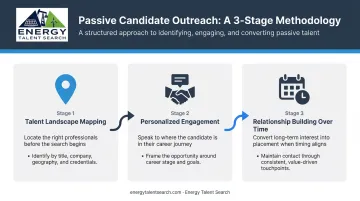
Effective outreach for specialized roles isn't a mass email blast. It involves:
- Talent landscape mapping — identifying professionals by title, company, geography, and credentials
- Personalized engagement — framing opportunities in terms of a candidate's career stage and goals, not just a job description
- Relationship building over time — a candidate who says "not now" in January may be ready in April; maintaining that relationship is what converts interest into placement
This requires sector-specific knowledge. A recruiter who can't speak credibly about rig classifications or PPA structures won't get far with a candidate who can.
Why Generalist Sourcing Falls Short for Energy Hiring
Generalist recruiters typically rely on two inputs that fail in energy: keyword searches and active job seekers. The best energy candidates aren't keyword-optimized, and they aren't searching.
The Knowledge Gap Is Costly
Vetting a drilling engineer requires fluency in formation types, rig classifications, and well control procedures. Vetting a renewable energy project developer requires familiarity with interconnection queues, permitting timelines, and PPA structures. Without that knowledge, a generalist recruiter cannot:
- Meaningfully assess whether a candidate's experience actually qualifies them
- Communicate the opportunity in terms that resonate with a technical professional
- Distinguish whether upstream oil and gas experience translates to midstream infrastructure or offshore wind
Either outcome stalls the search: wrong candidates get presented, or strong candidates disengage because the conversation doesn't demonstrate credibility.
The Cost of Getting It Wrong
That credibility gap has a direct price tag. In safety-critical or compliance-driven roles, the consequences compound quickly:
- OSHA serious violations carry penalties of up to $16,550 per violation, with willful or repeated violations reaching $165,514
- Operational disruptions in field environments affect project timelines, crew safety, and client relationships
- Turnover in specialized roles restarts a sourcing cycle that already took months the first time
The DOE reports that 91% of fuels manufacturers experienced hiring difficulty — which means the margin for a wasted search engagement is thin. When the talent pool is this constrained, one misaligned placement can set a project back an entire hiring season.
What to Look for in a Candidate Sourcing Service for Energy Roles
Sector Specialization as a Non-Negotiable
"Energy" on a list of industries served doesn't constitute specialization. A genuine energy sourcing partner should speak fluently about:
- Upstream vs. midstream vs. downstream oil and gas distinctions
- Mining operations across exploration, extraction, and processing phases
- Renewable subsectors including solar, wind, offshore wind, hydrogen, and energy storage
- The specific compliance and credentialing requirements that govern each environment
Ask for evidence of this depth, not just a claim. Energy Talent Search covers the full spectrum from traditional oil and gas to emerging technology roles, with the subsector fluency to assess candidates across both.
Passive Candidate Access and Outreach Methodology
Ask directly: how does this service reach candidates who aren't job searching? Strong answers include:
- An existing network of engaged energy professionals built over time
- Personalized direct outreach rather than template blasts
- Methods for identifying candidates at competitor companies, within professional associations, and through industry referral networks
Energy Talent Search's model centers on headhunting passive candidates for niche engineering, technical, and hard-to-fill positions — passive outreach is the primary sourcing methodology, not a supplementary one.
Cultural Fit and Full-Scope Coverage
Two additional criteria belong on every evaluation checklist:
Cultural alignment matters especially in remote field environments and safety-critical projects. A technically qualified but operationally misaligned hire causes real disruption. Screening should evaluate work style, communication preferences, and team dynamic fit alongside credentials.
Breadth of coverage reduces vendor complexity. A sourcing partner who can scale from entry-level field technicians through executive leadership handles more without handoffs. Energy Talent Search places professionals at every level across disciplines including:
- Engineering and geoscience
- Operations and project management
- Safety (HSE)
- Energy finance and procurement
Transparency as a Differentiator
Reputable sourcing services are direct about what they can and cannot do. If a role falls outside their network, they refer clients to a better-positioned partner rather than accepting the engagement and underdelivering. Energy Talent Search treats this as a core operating principle: transparency and integrity come before volume.
How a Specialized Energy Sourcing Service Works
Discovery and Role Definition
A quality engagement begins before any candidate search. The sourcing partner conducts a thorough intake — not just reviewing the job description, but understanding:
- Operational context: team structure, project phase, site conditions
- Geographic requirements and any relocation or travel expectations
- Safety culture and compliance environment
- Growth trajectory and long-term workforce goals
This discovery phase determines whether the search targets the right profile or simply the broadest one.
Talent Mapping and Candidate Identification
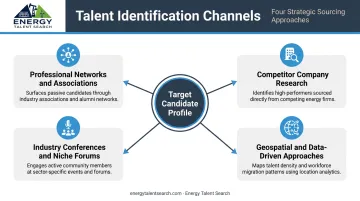
With a clear target profile, a specialized sourcer identifies candidates through channels that job boards never reach:
- Professional networks and associations relevant to the subsector
- Competitor company research to identify professionals with directly applicable experience
- Industry conferences and niche forums where senior technical professionals engage
- Geospatial and data-driven approaches that map where qualified professionals are concentrated, even without active job-seeking signals
Outreach and Relationship Building
Sector knowledge drives effective outreach. A sourcer who understands the role speaks to what actually motivates passive candidates to consider a move:
- Career growth and project scope
- Compensation structure and advancement path
- Team environment and site conditions
Many top candidates aren't ready to move immediately. Consistent relationship building keeps them engaged — converting long-term interest into placements when timing aligns.
Pre-Screening, Presentation, and Ongoing Support
Before a candidate is presented, a strong sourcing service verifies:
- Credentials and certifications relevant to the role
- Actual experience depth (not just resume language)
- Motivation and timeline alignment
- Cultural and operational fit with the client
Energy Talent Search's service extends through offer and onboarding — covering the stages where hard-to-fill placements most often fall through. Energy companies stay focused on operations while the search runs in parallel, managed by recruiters embedded in the same sector they're hiring for.
Frequently Asked Questions
What is candidate sourcing?
Candidate sourcing is the proactive process of identifying and engaging qualified professionals — including passive candidates who aren't actively job seeking — before any application is submitted. For specialized or hard-to-fill roles in energy, it's the primary method for reaching qualified professionals who will never respond to a job posting.
What is the average cost of a headhunter?
According to SIA's staffing industry survey, 20% of first-year salary is the most common direct-hire fee, with specialized firms ranging from 20–25% and executive retained searches using retainer structures. For energy roles, this cost is offset by faster time-to-fill and lower risk of a mis-hire in safety-critical or technically demanding positions.
What is the 70/30 rule in hiring?
The 70/30 rule refers to the general principle that roughly 70% of the workforce is passive (not actively job searching) while 30% is active. This ratio reinforces why proactive sourcing is essential — the majority of qualified energy candidates will never see a job posting, let alone apply to one, making direct outreach the only reliable path to that talent.
What is an ATS vs. CRM?
An Applicant Tracking System (ATS) manages active applicants through the hiring pipeline. A Candidate Relationship Management (CRM) system helps recruiters identify and nurture passive candidates over time. For hard-to-fill energy roles, the CRM function is often more critical — the best candidates need to be in your pipeline before a role opens.