Introduction
Energy companies face a hiring challenge that most industries don't: workforce needs can shift dramatically within a single quarter. When oil prices drop, a renewable project stalls, or a plant turnaround wraps up, headcount requirements change fast — and the cost of a permanent mis-hire in a technically specialized role is steep.
According to Gallup, replacing a technical professional costs roughly 80% of their annual salary. For energy roles that require years of credentialing to develop, that figure adds up quickly.
Contract-to-hire staffing offers a practical middle path for managing that risk: bring in a qualified professional on a fixed-term basis, evaluate real performance on real projects, and convert the best fits to permanent roles when the business case is clear.
Key Takeaways
- Contract-to-hire reduces costly mis-hires by providing a structured evaluation window before permanent commitment
- The model fits naturally with energy's project-driven cycles and fluctuating headcount demands
- Energy-specialized agencies reach passive candidates that job boards and general recruiters never surface
- Employers and candidates verify technical fit, safety culture, and team compatibility before any permanent commitment
- Conversion after a proven contract period drives stronger retention than direct hire
What Is Contract-to-Hire Staffing?
Contract-to-hire is a structured arrangement where a professional joins a company through a staffing agency on a fixed-term contract — typically three to twelve months — with both sides evaluating fit before a permanent offer is extended.
Three key distinctions set it apart from similar arrangements:
- W-2 employment, not 1099: The worker is employed by the staffing agency during the contract period, so the agency handles payroll taxes, workers' compensation, and compliance obligations.
- Not direct hire: Direct hire places a candidate straight onto the company's payroll from day one as a permanent employee — no trial period, no agency intermediary.
- Not pure temporary staffing: Temp roles have a defined end date and no expectation of conversion. Contract-to-hire is built around a path to permanence.
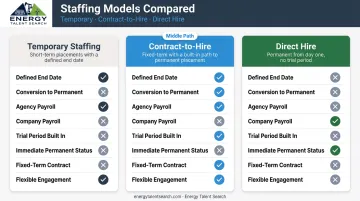
Contract-to-hire sits squarely in the middle: temporary in legal structure, permanent in intent. That distinction matters when energy companies are balancing project timelines, budget constraints, and long-term headcount decisions.
Why Energy Companies Are Turning to Contract-to-Hire Staffing
Project-Driven Work Cycles Create Natural Demand
Upstream exploration, pipeline construction, renewable installations, and plant turnarounds all operate on defined project lifecycles. Hiring permanent staff for every phase creates unsustainable overhead. Contract-to-hire lets energy companies bring in specialists for the duration of a project, then convert standout performers when a lasting role makes sense.
Commodity Volatility Makes Flexibility Essential
Energy employment doesn't move gradually — it moves in swings. U.S. oil and gas production employment fell 26%, or more than 142,000 jobs, between October 2014 and May 2016 following the oil price downturn. During the COVID-19 pandemic, oilfield services employment dropped 103,420 jobs — 13.5% — in just six months.
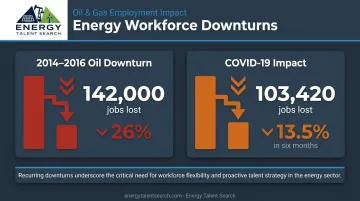
That kind of volatility demands a staffing model that scales in both directions — without mass layoffs on the way down or months-long permanent recruiting cycles on the way up.
The Energy Transition Is Creating Skills Gaps
As companies diversify into solar, wind, hydrogen, and battery storage, they often need expertise they don't have internally. U.S. clean energy employment added 142,000 jobs in 2023 alone — more than twice the rate of overall U.S. employment growth. Contract-to-hire lets companies bring in emerging technology specialists without a permanent commitment while the business case for a new discipline develops.
Specialized Talent Is Genuinely Hard to Find
The DOE reported that 76% of U.S. energy employers had difficulty finding qualified workers in 2024. Globally, approximately 60% of companies surveyed by the IEA reported labor shortages — with applied technical roles identified as the tightest area.
The roles driving those shortages require years of credentialing to develop:
- Reservoir and drilling engineers
- HSE and safety specialists
- Licensed project managers and construction supervisors
- Plant operators and pipefitters
- Line workers and field technicians
Most qualified candidates in these disciplines aren't actively job searching — which means reactive hiring rarely reaches them.
Key Benefits of Contract-to-Hire Staffing for Energy Companies
Faster Access to Specialized Talent
Energy-focused staffing agencies maintain pre-screened networks of professionals with hard-to-find credentials — safety certifications, engineering licenses, regulatory experience. Posting to job boards and waiting doesn't get you there.
The real advantage is access to passive candidates: professionals who aren't actively searching but are open to the right opportunity. This group represents a significant share of experienced energy talent, and they're largely invisible to internal HR teams working through public channels.
Agencies like Energy Talent Search use micro-market sourcing strategies : engaging professional associations, technical seminars, and peer referral networks to reach candidates who never see a standard job posting.
Reduced Hiring Risk Through a Built-In Trial Period
A contract period functions as a real-world working interview. Energy companies can evaluate:
- Technical performance on actual project deliverables
- Integration with existing safety protocols and reporting culture
- Team dynamics and communication style
- Judgment calls under field or operational pressure
This is especially valuable for senior or safety-critical roles where no amount of interview time can fully predict on-the-job performance. A conversation and a resume don't reveal how someone responds to an HSE incident or manages a complex shutdown timeline.
Workforce Scalability Without Long-Term Overhead
Contract-to-hire gives energy companies the ability to scale headcount during capital projects or production ramps, then convert only top performers to permanent roles. During the contract period:
- The staffing agency carries payroll taxes and workers' comp
- Benefits administration stays off the client's plate
- The company retains the option to not convert — without the legal and reputational weight of a layoff
For companies managing cyclical project demands, that flexibility keeps headcount agile without locking in overhead before a project's outcome is clear.
Improved Long-Term Retention
Employees who convert after a successful contract period start their permanent tenure with something most new hires lack: verified mutual fit. Both sides have seen each other in action. That reduces the uncertainty that drives early departures.
SHRM, citing Work Institute research, reports that attrition during an employee's first year accounts for roughly 40% of all employee turnover — the highest-risk window in any hire. A structured contract period directly addresses that window by ensuring both parties are genuinely aligned before a permanent commitment is made.
How the Contract-to-Hire Process Works in Energy Staffing
The process generally follows four stages:
Brief the agency — The energy company outlines the role: required technical skills, safety certifications, project timeline, compensation range, and cultural expectations. The more specific this brief, the better the shortlist.
Sourcing and screening — Recruiters search existing networks, actively source passive candidates, and screen against both technical and cultural criteria before presenting a qualified shortlist. For specialized energy roles, that means credential verification, safety training validation, and technical assessments — not just resume review.
Placement and contract period — The selected candidate begins work on the agency's payroll under a defined contract term. Performance is evaluated under actual project conditions — a far more reliable signal than any interview.
Conversion decision — At the end of the contract period, the company makes a permanent offer based on demonstrated performance — or, if the fit isn't right, the agency supports sourcing an alternative.
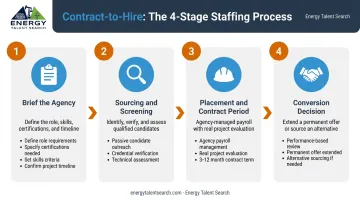
Contract terms in the energy sector typically run three to twelve months, depending on role complexity and project scope. Defining the contract term, performance benchmarks, and conversion criteria upfront prevents ambiguity when the decision point arrives — and keeps both sides focused on the same outcome from day one.
Common Challenges and How to Navigate Them
Conversion Isn't Always Guaranteed
A contractor may perform well, but if a project is cancelled or commodity prices shift, the permanent offer may not materialize. Energy companies should communicate conversion likelihood honestly upfront and define clear performance benchmarks. Candidates who understand the path to permanent employment stay more engaged throughout the contract.
Contractor Disengagement Is a Real Risk
Workers who know their status is temporary may pull back from team dynamics or longer-term initiatives. Counter this by onboarding contract workers with the same rigor as permanent staff. Three practices make a real difference from day one:
- Safety culture orientation covering site-specific protocols and values
- Team introductions that position the contractor as a full contributor
- Clear performance expectations tied to the conversion timeline
Worker Misclassification Creates Legal Exposure
Beyond team dynamics, there's a compliance risk that catches energy companies off guard. Treating a contract-to-hire worker like an independent contractor — when the agency relationship should classify them as W-2 — can trigger back taxes, penalties, and liability. Partnering with a staffing agency that actively manages employer-of-record compliance is the most reliable way to avoid that exposure.
What to Look for in an Energy Sector Contract-to-Hire Staffing Partner
Not all staffing agencies understand the energy industry. In this sector, that gap matters — an agency without energy-specific expertise may struggle to assess technical credentials, understand safety culture expectations, or access the passive talent networks where experienced energy professionals actually live.
When evaluating a staffing partner, look for:
- Demonstrated energy sector track record across oil and gas, renewables, mining, and related disciplines
- Ability to place across levels, from field technicians to executive leadership
- Sourcing strategies that reach passive candidates, not just active job seekers
- A vetting process that goes beyond resumes — credential verification, safety certification review, and technical assessments
- Transparent communication, including honesty about fit when a role isn't right for their network
Energy Talent Search, headquartered in Denver, Colorado, is built around these same criteria. The agency brings decades of experience placing technically specialized candidates across oil and gas, renewable energy, manufacturing, and mining — with a process that prioritizes genuine fit over placement volume. When they're not the right match for a client's needs, they refer out directly rather than force a fit.
Use these questions to qualify any agency before signing:
- How familiar are you with the specific roles we're hiring for?
- How do you source passive candidates in this discipline?
- What does your screening process look like for safety-critical roles?
- How do you handle situations where a candidate isn't working out mid-contract?
Agencies with real energy sector depth will answer each of these with specifics. Vague responses are a reliable signal to keep looking.
Frequently Asked Questions
Is a contract-to-hire position worth it?
For energy employers, it reduces the risk of costly permanent mis-hires in technical roles before a full commitment is made. For candidates, it offers a path to a permanent position while allowing time to evaluate the company's safety culture, team dynamics, and growth opportunities. It's a lower-risk entry point for both sides.
Do contract-to-hire positions usually result in a job offer?
Conversion is common when performance is strong and business conditions are stable, but it's not guaranteed. Project continuity, budget cycles, and organizational fit all play a role. Both parties should clarify conversion expectations and performance benchmarks before the contract begins to avoid misaligned assumptions.
Can you quit a contract-to-hire position?
Early termination is generally possible, but the terms depend on what's in the contract. Leaving before the agreed end date can strain the working relationship and affect professional reputation in a sector where networks are tight. Candidates should review termination clauses carefully before signing.
What roles do energy companies most commonly fill through contract-to-hire staffing?
Common placements include project engineers, HSE specialists, field supervisors, geologists, renewable energy technicians, operations managers, and accounting and finance professionals supporting energy operations.
How long do contract-to-hire positions in the energy sector typically last?
Most arrangements run three to twelve months, depending on project scope and role complexity. The timeline, key deliverables, and evaluation criteria should be defined in the agreement upfront. Ambiguity about conversion criteria creates friction for both the company and the contractor.
What's the difference between contract-to-hire and direct hire for energy companies?
Direct hire places a candidate permanently on the company's payroll from day one. Contract-to-hire starts with a trial period through the staffing agency, giving energy companies flexibility and risk reduction before a long-term commitment is made. The trade-off is a slightly longer path to full integration, though for technically specialized roles, that evaluation window is often worth it.