
Introduction
Picture this: three field engineer roles sitting open for four months. Two staffing agencies delivering candidates who don't meet the technical requirements. Internal HR spending more time chasing vendors than actually hiring. For energy companies, this is routine.
The problem isn't effort. It's structure. When hiring is fragmented across multiple vendors with no single point of accountability, results are inconsistent and visibility is nonexistent.
A recruitment managed service addresses that gap directly. In the energy context, it means outsourcing oversight and execution of your hiring function — or a defined portion of it — to a specialized external partner who takes full accountability for getting the right people in the door.
This article explains what a recruitment managed service is, why the energy sector's hiring complexity makes it particularly well-suited to this model, what it does in practice, and how to evaluate potential partners.
Key Takeaways
- A recruitment managed service gives energy companies one accountable partner for sourcing, screening, compliance, and reporting — not another vendor to manage.
- Energy hiring demands specialized credentials, project-based flexibility, and energy transition expertise that generalist staffing firms can't reliably deliver.
- The right partner brings deep sector knowledge across oil and gas, renewables, and mining — not just general recruiting capability.
- Evaluate partners on sector specialization, passive candidate reach, compliance depth, and transparency.
What Is a Recruitment Managed Service?
A recruitment managed service — commonly called an MSP (Managed Service Provider or Managed Service Program) — is a model where an external partner takes primary responsibility for managing a company's recruitment function, or a defined portion of it. That means owning sourcing, screening, supplier management, compliance, and reporting as an ongoing function — not just filling roles on request.
The terminology can cause confusion. "MSP" refers to both the program itself (Managed Service Program) and the entity running it (Managed Service Provider). Either way, the defining characteristic is the same: the external partner manages end-to-end hiring activity rather than simply filling individual requisitions when asked.
How It Differs from Traditional Staffing
The distinction matters:
- Traditional staffing agency: Fills a specific role when requested. Transaction-based. No ongoing accountability for the broader hiring function.
- Recruitment managed service: Takes structural, ongoing responsibility for the talent acquisition process — including vendor oversight if multiple suppliers are involved.
Traditional staffing responds to individual requests; a managed service runs the entire hiring function continuously.
Where VMS Technology Fits
Many larger MSP programs use a Vendor Management System (VMS) — software that centralizes requisition tracking, supplier performance data, spend reporting, and worker onboarding. For complex, high-volume programs, a VMS provides the operational infrastructure.
Boutique managed service models in specialized sectors like energy often take a more relationship-driven approach. Technology handles the administrative layer; deep knowledge of energy roles, markets, and candidate behavior is what actually drives results.
Scope Varies by Need
Recruitment managed services can cover:
- Contingent and contract workforce only
- Permanent placements only
- Both contingent and permanent hiring
- A hybrid of elements from MSP and RPO (Recruitment Process Outsourcing)
The right scope depends on where hiring is failing: whether that's contractor management, permanent technical placements, supplier coordination, or all three. Identifying that gap is the starting point.
Why Energy Hiring Demands a Specialized Recruitment Managed Service
Most industries struggle with talent shortages. Energy companies face that problem layered on top of several others that make the challenge qualitatively different.
The Scale of the Shortage
The numbers are stark. According to the IEA's World Energy Employment 2025 report, more than half of the 700+ organizations surveyed — companies, unions, and educational institutions — reported critical hiring bottlenecks. Around 60% said shortages were already affecting project schedules, operational reliability, or cost control.
In the United States specifically, 76% of energy employers reported difficulty finding qualified workers, with electric power generation hitting 85% difficulty. The roles most affected: electricians, pipefitters, electrical power-line workers, and engineers.
The Retirement Problem
This shortage has a structural cause that isn't going away. Across advanced economies, the energy sector has 2.4 near-retirement workers for every worker under 25. Through 2035, two out of every three new hires will be needed simply to replace retirees — not to grow. More than one-quarter of US oil and gas employees are approaching retirement age, with maintenance and repair occupations especially exposed.
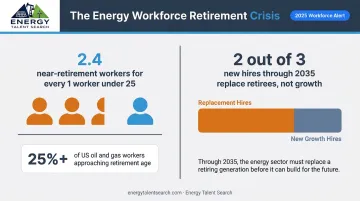
A reactive, ad-hoc recruiting approach cannot build the succession pipelines this situation demands — which is precisely where a managed service partner adds structural value.
Dual-Sector Hiring Pressure
Energy companies today face a hiring challenge that doesn't exist in most other sectors: they must staff traditional fossil fuel operations while simultaneously building out renewable energy teams.
These aren't interchangeable talent pools. A petroleum engineer and a wind energy engineer have different credential requirements, different labor markets, and different compensation benchmarks. Managing both simultaneously through fragmented vendors is how critical roles stay open for months.
Cyclical Workforce Demand
Oil and gas employment swings dramatically with market conditions. BLS data shows drilling employment ranging from 30,350 to 101,828 between 2014 and 2022 — a nearly threefold variation. Solar and wind construction create similar surges tied to project timelines.
Energy companies need a recruitment partner that can scale sourcing capacity up during ramp-ups and back down without losing continuity — exactly what contract and project staffing models, embedded within a managed service arrangement, are built to deliver.
Compliance Stakes Are Higher Here
In most industries, a compliance failure in hiring is a paperwork problem. In energy, it can be a safety incident or a regulatory penalty. Field roles carry requirements under OSHA's oil and gas extraction guidance and 29 CFR 1910.269 for electric power operations, covering everything from confined space entry to minimum approach distances for energized parts.
Worker misclassification — contractor vs. employee — triggers separate DOL exposure under FLSA. All of these are hiring criteria that must be verified and documented before any placement goes forward.
What Does a Recruitment Managed Service Do for Energy Companies?
The scope of what a managed service handles goes well beyond sourcing. Here's how the function breaks down in practice:
Sourcing and Candidate Identification
A managed service partner actively builds talent pipelines — including passive candidates not actively job-searching. In energy, where the most sought-after engineers and technical leads rarely post their resumes on job boards, passive candidate outreach is often the only reliable path to top-tier talent.
Energy Talent Search, for example, centers its sourcing methodology on identifying passive candidates for niche technical roles, using predictive workforce analytics and targeted outreach rather than waiting for applications.
Screening and Qualification
Screening for energy roles isn't generic. A structured qualification workflow should include:
- Technical competency assessment by discipline (upstream, midstream, renewable)
- Safety certification verification — OSHA credentials, offshore survival training, well control certifications
- Background checks and reference validation
- Equipment-specific qualification review
- Cultural and operational fit evaluation
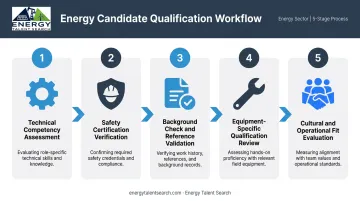
By the time a candidate reaches the hiring team, the heavy lifting is already done.
Vendor Coordination (Where Applicable)
Some energy companies run multiple staffing vendors simultaneously — which creates real coordination overhead. A managed service steps in as the program manager: distributing requisitions, tracking supplier delivery metrics, and enforcing consistent quality standards across every vendor. Without that structure, each agency operates in isolation, and quality varies widely from one hire to the next.
Workforce Reporting and Analytics
A managed service provides visibility into:
- Time-to-fill by role type and location
- Cost-per-hire trends over time
- Supplier performance comparisons
- Market compensation benchmarks
For HR and operations leaders, that data shifts hiring from reactive fire-fighting to deliberate workforce planning.
Administrative and Compliance Management
The managed service handles offer management, onboarding coordination, worker classification review, and regulatory documentation — reducing administrative burden on internal HR teams and lowering legal exposure.
Key Benefits of a Recruitment Managed Service for Energy Hiring
Faster Access to Specialized Talent
Because a managed service partner maintains active pipelines in the energy sector, they can reduce time-to-fill for critical technical roles compared to reactive, one-off recruiting. This matters most during project ramp-ups — upstream drilling campaigns, wind farm construction phases, solar installation pushes — where a delayed hire can hold up an entire project schedule.
Speed matters, but so does reach. Experienced engineers and technical leads who aren't actively applying anywhere are reachable through established relationships, not job board postings.
Greater Visibility and Cost Control
When hiring is scattered across multiple agencies and internal hiring managers, no one has a complete picture of what recruitment actually costs. A managed service consolidates that data.
Leadership gets clear reporting on what recruitment actually costs and where the gaps are:
- Total spend visibility across all vendors and internal activity
- Cost-per-hire trends that reveal inefficiencies over time
- Vendor performance data to identify which partners deliver and which don't
- Workforce intelligence that informs budget planning and hiring strategy
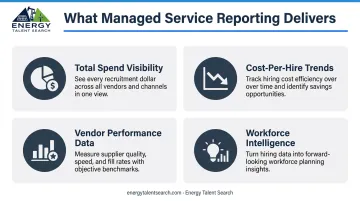
This replaces the "black box" problem with data that actually drives decisions.
Reduced Hiring Risk and Compliance Assurance
In energy field operations, a mis-hire creates both performance gaps and real safety exposure. A structured screening process calibrated to energy-specific technical and safety requirements reduces that risk systematically, rather than leaving it to inconsistent vendor quality.
Compliance management is embedded throughout, not treated as an afterthought. That includes:
- Certification and licensure verification for field and technical roles
- Worker classification review to reduce misclassification liability
- Regulatory documentation aligned with OSHA and project-specific requirements
How to Choose the Right Recruitment Managed Service Partner for Energy Hiring
Industry Specialization Is Non-Negotiable
A partner with general staffing experience who has "done some energy work" is not the same as a partner with deep sector expertise across oil and gas, renewables, mining, energy infrastructure, and manufacturing.
Energy Talent Search, for example, brings decades of collective experience specifically in energy sector recruitment, spanning traditional and renewable energy, manufacturing, mining, and related fields. That sector depth allows a partner to assess whether a candidate's credentials match the operational realities of a role — not just the job title on the posting.
Passive Candidate Access
Ask potential partners directly: can they demonstrate access to professionals not actively on the job market?
The most in-demand energy talent is rarely found through job postings. Experienced petroleum engineers, renewable energy project managers, and senior HSE professionals typically aren't browsing job boards. A partner whose sourcing strategy depends primarily on active applicants will consistently struggle with the roles that matter most.
Look for demonstrated access through built networks, headhunting capability, and a track record of placing professionals who weren't looking to move.
Transparency and Accountability
Look for partners who offer:
- Clear reporting on candidate evaluation criteria and process steps
- Honest communication when a candidate isn't the right fit — rather than forcing a placement to close a deal
- A referral posture: if they can't fill a role well, they say so rather than deliver a substandard hire
Energy Talent Search builds this posture into every engagement. Fit matters more than transaction volume — and that includes referring clients elsewhere when another firm is genuinely better positioned for a specific role.
Frequently Asked Questions
What does MSP mean in staffing?
MSP stands for Managed Service Provider or Managed Service Program. It describes a model where an external partner takes responsibility for managing a company's contingent or broader recruitment function — including sourcing, compliance, vendor management, and reporting — rather than simply filling individual roles on request.
What is the difference between MSP and SaaS?
An MSP is a recruitment and workforce management service (people, process, and program delivery). SaaS is software delivered via the cloud. Many MSP programs use SaaS-based Vendor Management Systems as operational tools, but the MSP itself is a managed service, not a software product.
What is the difference between an MSP and an RPO for energy hiring?
An RPO (Recruitment Process Outsourcing) focuses on permanent-hire recruitment and the full lifecycle for direct employees, while an MSP traditionally manages contingent or contract workforce. Many energy companies use elements of both — and some specialized partners offer integrated approaches that span both worker types.
How does a recruitment managed service reduce hiring risk in energy?
It embeds structured screening calibrated to energy-specific requirements (certification verification, compliance documentation, classification review) and applies consistent hiring standards across all requisitions. The result is fewer costly mis-hires and reduced exposure to regulatory penalties.
What types of roles can a recruitment managed service fill for energy companies?
The spectrum is wide: field technicians, engineers, drilling supervisors, project managers, HSE professionals, environmental planners, finance and accounting roles, and executive leadership. The right partner will align their coverage to your specific workforce requirements and sector focus.
How do I know if my energy company needs a recruitment managed service?
Consider it when you face recurring difficulty filling specialized roles, are managing multiple staffing vendors with inconsistent results, lack internal visibility into recruitment spend or performance, or are managing rapid workforce growth tied to project expansions or energy transition.