
Introduction
The SEC's workforce has shrunk by roughly 17% since the start of fiscal year 2025, dropping from approximately 4,907 employees to around 4,000, according to the agency's own FY2025 Financial Report. Contractor headcount fell even further — down about 27%. This isn't gradual attrition. It's a structural reduction unfolding in real time.
For publicly traded energy companies, this creates a genuine problem. Fewer examiners mean longer gaps between inspections, and reduced Corporation Finance staff means slower feedback on disclosures. When the SEC does act, the consequences have more weight behind them.
Energy companies that treat reduced SEC oversight as breathing room are likely to find themselves understaffed exactly when a regulatory inquiry arrives.
This post covers what's actually happening at the SEC, what it means for energy companies specifically, which roles to prioritize hiring, and how to find qualified candidates in a tight hiring market.
Key Takeaways
- The SEC has lost roughly 17% of its workforce since October 2024, with approximately 4,000 employees remaining and contractor headcount down ~27%
- Enforcement and Examinations divisions — which monitor public companies and investment advisers — lost 18% and 14% of staff respectively
- Reduced oversight creates compliance drift risk, not relief; enforcement actions still totaled 456 in FY2025
- Internal compliance, audit, and SEC-reporting professionals are in high demand — and the hiring window is narrow
- Specialized energy-sector recruiters with passive candidate access cut time-to-hire for these niche roles
SEC Staffing Cuts: What's Actually Happening
The numbers are straightforward. According to GAO's verified report on SEC workforce reductions, the SEC began fiscal year 2025 with 4,907 employees. By year-end, approximately 4,000 remained — a net decline of 17%. A total of 871 employees departed during the year, representing an 18% departure rate.
Contractor reductions hit even harder. The SEC reported roughly 2,300 contractors remaining after an approximately 27% cut during the same period.
What Drove the Departures
Several overlapping forces accelerated attrition:
- Deferred Resignation Program ("Fork in the Road"): 170 SEC employees accepted and moved to administrative leave through September 30, 2025
- VERA/VSIP early retirement incentives: 430 employees departed by April 2025 under these programs, with 42 more accepting a September offer
- Extended hiring freeze: Active since September 2023, extended again in January 2025; the SEC requested exemptions for only 18 positions by mid-2025 and relied on 88 temporary promotions to fill gaps
- Planned regional office closures: The SEC announced lease terminations for Los Angeles and Philadelphia in March 2025 — though both decisions were reversed by August 2025
Division-Level Breakdown
| Division | Starting Staff | FY2025 Departures | Departure Rate |
|---|---|---|---|
| Enforcement | 1,305 | 235 | 18% |
| Examinations | 1,079 | 150 | 14% |
| Corporation Finance | 429 | 58 | 14% |
| Investment Management | 219 | 53 | 24% |
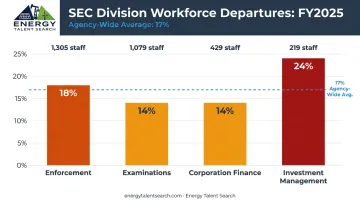
Investment Management — which oversees energy-focused funds and investment advisers — saw the steepest proportional losses at 24%. Enforcement matched the agency-wide average. For energy companies, that means fewer staff reviewing filings, processing guidance requests, and conducting examinations — with no timeline for recovery.
How Reduced SEC Staffing Affects Energy Companies Directly
Fewer staff doesn't mean less risk. The SEC filed 456 enforcement actions in FY2025 and returned approximately $262 million to harmed investors. Chairman Atkins has publicly emphasized a shift away from "regulation by enforcement" — but that doesn't mean enforcement has gone quiet.
The Inspection Gap
With fewer examiners in Examinations and a hiring freeze limiting replacements, inspection cycles for registered investment advisers, broker-dealers, and energy-sector funds are likely to lengthen. For publicly traded oil and gas operators and renewable energy infrastructure developers, this creates a specific hazard: compliance drift.
When inspections come infrequently, disclosure errors compound across filing cycles. Three risk areas are especially vulnerable:
- Reserve reporting inaccuracies that accumulate without triggering a comment letter
- XBRL tagging mistakes that persist through multiple filings undetected
- Incomplete segment disclosures that surface all at once when examiner scrutiny returns
The Guidance Vacuum
GAO found that 33 of 61 interviewed SEC employees reported institutional knowledge loss as a direct consequence of staffing reductions. One supervisor noted that a disclosure-review team had lowered its goals by 20% due to personnel loss.
No-action letter responsiveness has already shifted. Corporation Finance announced in November 2025 that it would not respond substantively to most Rule 14a-8 requests for the 2025–2026 proxy season. Informal guidance, which companies previously used to calibrate disclosure decisions, is becoming less reliable for energy filers navigating complex asset structures.
Segment Reporting Scrutiny Is Rising
One counterintuitive finding from Deloitte's SEC comment letter analysis: while the total number of comment letters declined by 10% in review year 2025, segment-reporting comments rose from 16% to 23% of all reviews generating comment letters. Energy companies with complex operating structures — upstream/midstream/downstream splits, renewables alongside conventional assets — should treat segment disclosure as a heightened risk area right now.
The Compliance Gap Energy Companies Now Face
The secondary effect of SEC attrition is a talent crunch in the private sector. When experienced examiners, enforcement attorneys, and securities accountants leave the agency, they enter private practice, join in-house teams, or become consultants — and they're in demand from the moment they do.
What This Means for Internal Teams
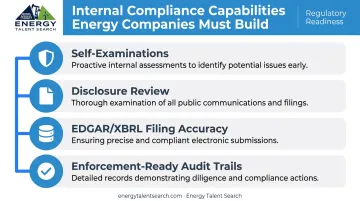
Energy companies that previously relied on the cadence of SEC examinations as an implicit compliance check now face a different reality. Internal teams need to be capable of:
- Conducting self-examinations against SEC examination priorities
- Reviewing 10-K and 10-Q disclosures for accuracy without waiting for comment letters
- Maintaining continuous EDGAR filing accuracy and XBRL tagging quality
- Building audit trails that can withstand scrutiny if an enforcement inquiry arrives
Many energy companies — particularly mid-sized operators and renewable infrastructure developers — don't currently have that internal depth.
The Accounting and Finance Dimension
That depth gap doesn't stop at legal or compliance headcount — it runs straight through the finance function. SEC compliance for public energy companies is inseparable from financial reporting quality. Regulation S-X Rule 4-10 governs oil-and-gas accounting. Regulation S-K Subpart 1200 covers reserve disclosures. XBRL structured data filing accuracy is a stated SEC review priority.
Hiring a compliance attorney alone doesn't solve this. Energy companies need accounting and finance professionals who understand the intersection of SEC disclosure requirements and energy-specific reporting, and that combination is hard to find on the open market.
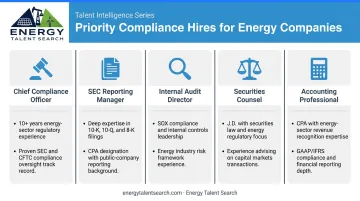
Key SEC-Related Roles Energy Companies Should Be Hiring Now
These are the positions most directly affected by the compliance gap created by SEC staffing reductions:
Chief Compliance Officer (CCO) or VP of Compliance
The SEC's own guidance specifies that a CCO must have sufficient seniority and authority to compel adherence to compliance policies. For energy companies, this means someone who can own the compliance program — not just maintain it. Prioritize candidates with prior SEC staff experience or a track record building compliance functions at publicly traded energy companies.
SEC Reporting Manager
This role owns the 10-K, 10-Q, and 8-K filing process. In the current environment — where fewer Corp Finance staff are reviewing submissions and segment-reporting scrutiny is rising — accuracy and timeliness are non-negotiable. Look for candidates with EDGAR and XBRL experience and familiarity with oil-and-gas-specific disclosure requirements under Reg S-K Subpart 1200.
Internal Audit Director
The IIA's 2025 North American Pulse report found that 68% of internal audit leaders had recruited in the prior 12 months. Competition for experienced audit leadership is real. For energy companies, the priority is candidates who understand how to build audit programs that address SEC-facing risks, not just operational controls.
Securities Counsel or Regulatory Affairs Attorney
With the SEC's formal guidance processes slowing down, having in-house securities counsel who can interpret regulatory developments and advise on disclosure decisions without waiting for agency feedback is essential.
Accounting Professionals with Public Company Experience
Big Four alumni with energy-sector clients, or accountants who've worked inside publicly traded operators, bring specific knowledge that's hard to replicate. Strong candidates typically offer:
- Reserve reporting and depletion accounting under SEC guidelines
- Cost-of-sales presentation specific to upstream or midstream operations
- Internal control environments that meet SEC scrutiny at audit time
Across all five roles, the candidates who move fastest in this market share one trait: they've built compliance functions from scratch, not just inherited them. When the regulatory environment shifts, that experience is the difference between staying ahead and scrambling to catch up.
How to Find Qualified Compliance and Finance Talent for Energy Firms
The talent pool is narrow. The best candidates are rarely browsing job boards — they're employed, performing well, and only reachable through direct, personalized outreach.
Effective Sourcing Approaches
- Many of the 871 professionals who departed the SEC in FY2025 have moved into private-sector compliance, legal, and finance roles — carrying institutional knowledge directly relevant to energy companies navigating the same regulatory environment.
- Organizations like the Society of Corporate Compliance and Ethics (SCCE) and AICPA's energy and utilities groups surface senior candidates before they ever hit the open market.
- A specialized recruiter with existing energy-sector relationships reaches passive candidates through direct, credible outreach — and already knows which ones are quietly open to the right opportunity.
Why Energy-Sector Alignment Matters
A compliance professional with generic corporate experience faces a real ramp-up period at an energy company. The learning curve isn't trivial — it includes:
- Reserve reporting and segment disclosure requirements specific to energy
- Environmental and operational risk factors that don't appear in standard corporate compliance work
Hiring candidates who already understand the energy regulatory landscape — even if they haven't held the exact role title before — shortens that curve and reduces institutional risk.
Why Partnering with an Energy-Focused Staffing Agency Makes the Difference
Energy Talent Search operates differently from generalist staffing firms in the ways that matter most for compliance, finance, and audit hiring.
Rather than submitting a high volume of loosely qualified candidates, the agency builds a tailored search for each engagement — matching candidates on technical qualifications, energy-sector knowledge, and organizational fit. For regulatory roles where a misaligned hire carries real legal and financial risk, that distinction directly affects your exposure.
Passive candidate sourcing is where this approach stands apart. Energy Talent Search's model is built around headhunting professionals who aren't actively job-seeking — exactly the profile that dominates the senior compliance and finance talent pool. Generalist firms that rely on active applicants don't reach this segment.
The accounting and finance vertical covers the full range of roles energy companies need for SEC-facing teams:
- Financial accountants with regulatory compliance expertise
- Audit professionals and tax specialists
- Senior leaders including Corporate Controller and Chief Accounting Officer
For companies building or expanding these internal functions, that combination of energy-sector knowledge and finance specialization is hard to replicate with a generalist firm.
If you're ready to start sourcing compliance, finance, or audit talent for your energy company, contact Energy Talent Search at (720) 260-4250 or info@energytalentsearch.com.
Frequently Asked Questions
How many staff does the SEC have?
As of the end of fiscal year 2025, the SEC employs approximately 4,000 employees — down from 4,907 at the start of the fiscal year, a net decline of about 17%. Contractor headcount also fell approximately 27%, to around 2,300. Check the SEC's official site for the most current figures.
Are SEC employees federal employees?
Yes. SEC staff are federal government employees, subject to federal employment policies including the hiring freeze and buyout programs introduced in early 2025. Deferred resignation and early retirement incentives were the primary drivers of FY2025 departures.
What does the SEC do?
The SEC is the U.S. federal agency responsible for enforcing securities laws, regulating financial markets, overseeing public company disclosures, and protecting investors. These functions directly affect publicly traded energy companies and energy-sector investment advisers and funds.
What do SEC staffing cuts mean for energy companies?
Fewer examiners and Corp Finance staff mean longer gaps between inspections, reduced informal guidance, and less capacity for agency responsiveness. When the SEC does act — as it did with 456 enforcement actions in FY2025 — the stakes are concentrated and high. Energy companies can't afford to treat reduced oversight as reduced risk.
What compliance roles should energy companies hire for right now?
Priority hires right now include:
- Chief Compliance Officers
- SEC Reporting Managers
- Internal Audit Directors
- Securities Counsel
- Accounting professionals with public company and energy-sector disclosure experience
How can a staffing agency help energy companies respond to SEC changes?
A specialized energy recruitment firm like Energy Talent Search can source pre-vetted compliance and finance candidates — including passive talent not visible on the open market — reducing time-to-hire and ensuring candidates understand both SEC requirements and the energy sector's operational realities.