Introduction
Energy sectors — oil and gas, renewables, mining, and construction — don't hire like most industries. Workforces expand rapidly for drilling campaigns, contract sharply when commodity prices shift, and surge again during plant turnarounds or renewable construction phases. According to BLS data from July 2023, construction and extraction occupations carry a 15.1% independent-contractor rate, reflecting just how central non-permanent labor is to energy project delivery.
Finding field engineers, HSE specialists, and geoscientists with valid safety credentials (TWIC, H2S Alive, HUET) on short notice is a different problem entirely. These professionals aren't on job boards. Sourcing, screening, and deploying them requires sector-specific expertise most generalist staffing firms don't have.
That expertise gap is exactly what this post addresses. Below are the top contingent workforce management companies serving the energy sector, what each does best, and how to match the right partner to your organization's scale and complexity.
Key Takeaways
- CWM in energy covers the full non-permanent worker lifecycle across technically demanding, compliance-heavy project environments
- Specialized agencies excel at targeted placements; enterprise MSPs manage entire multi-vendor programs
- Safety certifications (TWIC, H2S, HUET) and worker classification compliance are non-negotiable screening criteria
- Company size and project complexity should drive your choice between boutique and enterprise partners
- Energy Talent Search, Airswift, Brunel, Hays Energy, and AGS each fill a distinct position in the energy CWM landscape
What Is Contingent Workforce Management in the Energy Sector?
Contingent workforce management (CWM) is the structured oversight of non-permanent workers (contractors, temporary staff, independent consultants) covering sourcing, onboarding, compliance, payroll, and offboarding. SHRM describes it as aligning independent experts with organizational priorities through structured planning.
Why Energy Is Different
The energy sector's dependence on contingent labor is driven by structural factors that don't exist in most other industries:
- Project-based cycles — Drilling campaigns, plant turnarounds, and refinery maintenance require rapid workforce expansion, then rapid wind-down
- Seasonal construction — Renewable energy buildouts follow installation seasons, creating sharp labor spikes
- Commodity market volatility — Headcount decisions shift quickly when oil prices move
The Reuters coverage of North American oilfield labor shortages captures how acute this gets: Patterson-UTI hired 3,000 workers in 2021 and immediately sought 3,000 more in 2022. One fracking company reported delays of two weeks to a month simply from labor unavailability.
Speed is only part of the challenge. Energy contingent workers frequently carry credential requirements that general workforce platforms aren't built to screen for, including:
- TWIC cards for secure maritime facility access
- H2S Alive certification for hydrogen sulfide environments
- HUET training for offshore helicopter travel
Three CWM Approaches
| Approach | What It Does | Best For |
|---|---|---|
| Specialized Staffing Agency | Sources and places individual workers directly | Targeted, technically skilled hires |
| Managed Service Provider (MSP) | Oversees entire contingent programs and vendor networks | Large operators managing multi-vendor programs |
| Vendor Management System (VMS) | Software platform for internal program management | Organizations with in-house CWM teams |
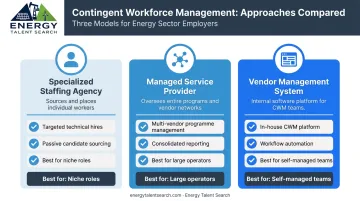
Energy companies often combine approaches, pairing a specialized agency for hard-to-fill technical roles with an MSP for overall program oversight.
Top Contingent Workforce Management Companies for Energy
The companies below were selected based on energy sector specialization, placement capabilities, compliance track record, service model, and industry reputation.
Energy Talent Search
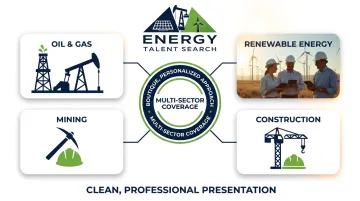
Denver-based Energy Talent Search is a boutique recruitment agency with decades of collective experience connecting skilled professionals with employers across oil and gas, renewable energy, mining, construction, manufacturing, technology, and accounting and finance. The agency handles both contingent/contract and permanent placements, from entry-level field roles to executive leadership.
What sets Energy Talent Search apart is its deliberately personalized approach. Rather than filling headcount, the agency emphasizes culture and values alignment in every placement — and its transparent referral policy means clients are directed elsewhere if the agency isn't the right fit for a particular search. That kind of candor is unusual in contingent staffing.
The agency's passive candidate sourcing capability is particularly relevant for energy contingent roles, where the most qualified drilling supervisors, field engineers, HSE specialists, and geoscientists aren't browsing job boards.
| Category | Details |
|---|---|
| Service Model | Boutique, personalized contingent and direct-hire recruitment; white-glove candidate matching from entry-level to executive |
| Energy Sectors Covered | Oil and gas, renewable and alternative energy, mining, construction, manufacturing, technology, accounting and finance |
| Key Differentiator | Passive talent sourcing, culture-fit alignment, and a referral policy when not the right fit |
Airswift
Airswift is a global workforce solutions provider focused exclusively on energy, process, and infrastructure sectors. Operating across more than 70 countries with roughly 9,000 contractors supported, the firm was recognized as the fourth-largest global engineering staffing firm by SIA in 2023.
Services span contingent staffing, employer of record (EOR), workforce management, and contractor payroll — with in-house immigration and mobility support included.
For large upstream and midstream projects requiring rapid cross-border deployment, Airswift's built-in immigration infrastructure is a meaningful advantage. A 2024 OxyChem engagement documented 280+ hires across 12 US sites with a 1.5-week average mobilization — though this reflects one client case, not an industry-wide benchmark.
| Category | Details |
|---|---|
| Service Model | Contingent staffing, workforce management, employer of record, and project-based labor solutions |
| Energy Sectors Covered | Upstream oil and gas, LNG, renewables, power generation, petrochemicals, and infrastructure |
| Key Differentiator | Global contractor network with built-in immigration, mobility, and compliance support for cross-border deployments |
Brunel
Headquartered in the Netherlands, Brunel operates across 120+ offices with more than 12,000 specialists in technical and engineering disciplines. The firm serves energy, oil and gas, mining, and renewables clients across Europe, Asia-Pacific, the Americas, and the Middle East, offering contingent staffing, longer-term secondment arrangements, and full contractor compliance management. Brunel has appeared on SIA's largest US and Canadian staffing firm lists.
The key distinction: Brunel's recruiters function as sector specialists rather than generalists. Sector depth means faster, more accurate matching for complex engineering and operations roles. Visa, payroll, and compliance management for international contractors is handled in-house, reducing the administrative load on energy companies running cross-border programs.
| Category | Details |
|---|---|
| Service Model | Technical contingent staffing, secondment, and international contractor management |
| Energy Sectors Covered | Oil and gas, offshore energy, renewable energy, mining, and petrochemicals |
| Key Differentiator | Specialist technical recruiters with deep sector expertise and cross-border contractor compliance management |
Hays Energy
Hays operates a dedicated energy practice covering oil and gas, power, utilities, and renewable energy — placing contingent and permanent professionals across engineering, geoscience, project management, HSE, and commercial functions. The firm maintains offices across North America, Europe, Asia-Pacific, and the Middle East, with particular strength at mid-to-senior technical placements on contract engagements.
The value proposition is scale with specialization. The energy practice operates with dedicated sector expertise embedded within a large international recruiting network — giving clients access to a vetted talent pool that smaller boutiques can't match in volume.
| Category | Details |
|---|---|
| Service Model | Specialist contingent and permanent recruitment with global reach across energy disciplines |
| Energy Sectors Covered | Oil and gas, power and utilities, renewable energy, and energy transition roles |
| Key Differentiator | Global footprint combined with dedicated energy practice expertise across engineering, geoscience, and HSE disciplines |
Allegis Global Solutions (AGS)
AGS is a leading Managed Service Provider and total workforce solutions partner for enterprise clients. Rather than placing individual workers, AGS manages entire contingent workforce programs end-to-end — supplier sourcing, vendor management, compliance, spend analytics, and program optimization — typically integrated with a VMS platform. The firm operates in 100+ countries and was recognized in Everest Group's 2025 Contingent Workforce Management PEAK Matrix Assessment.
For major energy operators, utilities, or EPC firms running multi-vendor contingent programs across dozens of sites, AGS offers the governance and analytics infrastructure that staffing agencies aren't designed to provide. The right fit here is a large operator managing hundreds of contractors across multiple supply chain tiers — not a renewable developer filling a handful of engineering roles.
| Category | Details |
|---|---|
| Service Model | End-to-end MSP program management, vendor oversight, and total workforce solutions |
| Energy Sectors Covered | Energy, utilities, oil and gas, construction, and industrial sectors |
| Key Differentiator | Enterprise-scale MSP with full contingent program governance, multi-vendor management, and workforce analytics |
How to Choose the Right CWM Partner for Energy
The most common mistake energy companies make when selecting a CWM partner is treating it like a general procurement decision. Choosing a generalist provider that doesn't understand TWIC card requirements, H2S certification validity windows, or the pace of offshore mobilization creates compliance exposure and deployment delays.
Selection Criteria That Actually Matter
- Energy sub-sector depth — Does the provider know upstream from midstream? Offshore from onshore renewables? Generic energy expertise isn't enough
- Certification screening capability — Can they verify OSHA compliance, TWIC status, HUET currency, and H2S credentials as part of standard intake?
- Worker classification rigor — Misclassification carries real cost. The DOL has recovered six-figure back-wage amounts from construction cases, and OSHA can cite both staffing agencies and host employers for shared violations
- Geographic alignment — Energy talent networks are regional. A firm strong in the Permian Basin may have limited reach in offshore Gulf of Mexico or Appalachian gas
- Service model fit — Boutique agencies serve focused, technical hiring needs; enterprise MSPs serve complex multi-vendor program management
Match Your Partner to Your Scale
| Organization Type | Better Fit |
|---|---|
| Single-project renewable developer scaling fast | Specialized boutique agency (e.g., Energy Talent Search) |
| Mid-size oil and gas operator with recurring contingent needs | Sector-focused staffing firm (e.g., Brunel, Hays Energy) |
| Global energy company needing cross-border deployment | International workforce solutions provider (e.g., Airswift) |
| Large operator managing complex multi-vendor programs | Enterprise MSP (e.g., AGS) |
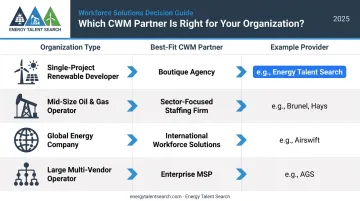
The right partner is the one with demonstrated depth in your specific sub-sector, certification requirements, and project geography — not simply the most recognizable name in the room.
Conclusion
The energy sector's contingent workforce needs are specialized enough that generalist staffing approaches consistently fall short. Technical credentials, project-driven hiring rhythms, safety compliance requirements, and tight deployment windows demand partners who understand the sector from the inside.
The gap between the right partner and the wrong one shows up in deployment speed, compliance exposure, and the caliber of talent you can realistically access — whether you're a renewable developer ramping up for construction season or a major operator running a complex contractor program.
That's where sector-specific recruitment makes a measurable difference. If your organization operates in oil and gas, renewables, mining, or energy construction, Energy Talent Search brings cross-sector expertise across all four verticals alongside a candid, client-first approach — including a transparent referral policy when they're not the right fit. Reach out at info@energytalentsearch.com or (720) 260-4250 to discuss your contingent and direct-hire workforce needs.
Frequently Asked Questions
What is contingent workforce management in the energy sector?
CWM in energy is the structured process of sourcing, onboarding, paying, and managing compliance for non-permanent workers — contractors, temporary staff, and consultants — across oil and gas, renewables, and mining. It covers the full worker lifecycle, not just placement.
How do energy companies benefit from working with a specialized CWM company?
Specialized partners provide faster access to pre-screened, technically qualified talent, reduce compliance risk around worker classification and safety certifications, and allow companies to scale headcount with project cycles. There's no overhead of permanent hires when projects wind down.
What is the difference between a staffing agency and an MSP for energy contingent workforce management?
A staffing agency sources and places individual workers, making it a good fit for targeted or specialized hiring needs. An MSP oversees an entire contingent program — multiple vendors, compliance tracking, and analytics — and is better suited to large enterprise operators managing complex, multi-site programs.
What types of roles can contingent workforce management companies fill in energy?
Roles span field engineers, geoscientists, HSE specialists, project managers, drilling supervisors, pipeline operators, and construction personnel — as well as corporate functions like accounting, finance, and technology within energy organizations.
What compliance risks are unique to contingent workers in the energy industry?
Worker misclassification (contractor vs. employee), expired or unverified safety certifications (TWIC, HUET, H2S), co-employment liability, and jurisdiction-specific wage and labor law compliance all carry significant legal and financial exposure.
How do I choose the right contingent workforce management partner for my energy company?
Evaluate partners on energy sub-sector specialization, certification screening capability, geographic reach, and compliance rigor. Also consider whether their service model — boutique agency or enterprise MSP — fits the scale and complexity of your program.