Introduction
The energy sector is expanding on nearly every front — infrastructure investment, the energy transition, and rising power demand are all driving headcount needs up. Yet many employers are struggling to fill critical technical roles, and experienced professionals are leaving faster than they can be replaced.
Recruitment and retention are two sides of the same challenge. What a company promises during hiring must match the day-to-day reality employees encounter — otherwise, turnover accelerates and the talent gap compounds.
According to the IEA's World Energy Employment 2025 report, qualified entrants to the energy workforce would need to increase by roughly 40% by 2030 just to prevent the global skills mismatch from worsening. That's not a distant scenario — it's a pressure energy employers are already feeling.
This guide covers practical strategies across the full talent lifecycle: sourcing passive candidates, building an employer brand that resonates, structuring onboarding that retains people, and using workforce data to sharpen hiring decisions at every stage.
Key Takeaways
- Misaligned hiring drives early attrition — and sends employers back to square one at higher cost
- Top energy professionals are rarely job-searching; reaching them requires proactive outreach, not job board reliance
- NREL projects a ~124,000-worker gap in wind alone by 2030, with parallel shortfalls across solar, grid operations, and oil and gas
- Replacing a technical professional costs roughly 80% of their annual salary — retention is a financial priority, not a soft one
- Safety culture, career development, and mentorship are the strongest retention levers energy employers have
Why Recruitment and Retention Are Inseparable
Every experienced departure creates a vacancy that is slow and expensive to fill. Gallup estimates that replacing a technical professional costs roughly 80% of their annual salary — and that figure doesn't account for lost institutional knowledge, reduced team productivity, or the morale drag on colleagues left to cover the gap.
Energy employers also recruit from an unusually small pool. Petroleum engineers, grid operators, renewable energy technicians, environmental scientists — these are tight-knit professional communities where reputation travels fast. A weak retention environment doesn't just cost you the employee who left. It shapes how the next candidate perceives your organization before the first conversation even happens.
The Revolving Door Problem
Speed-driven hiring makes this worse. When companies prioritize filling a role quickly over filling it correctly, early attrition is predictable. The new hire discovers a mismatch — with the role, the culture, or the compensation — and leaves within months. The company returns to the top of the funnel with:
- A diminished candidate pool (word gets around)
- Higher costs than the original search
- A team that's skeptical another hire will stick
Breaking this cycle means addressing both sides at once. Retention data should directly inform your hiring criteria — and your hiring criteria should reflect what actually keeps people engaged once they're in the role.
The Aging Workforce Factor
This challenge is especially acute given workforce demographics. Median tenure in mining, quarrying, and oil and gas extraction was 5.7 years in January 2024, compared to 3.5 years across the broader private sector. That longer tenure reflects deep institutional knowledge — knowledge that cannot be quickly replaced through external hiring alone when experienced professionals retire or move on.
When mid-career professionals leave, they take process knowledge, client relationships, and site-specific expertise that no job posting can recover quickly.
The Unique Talent Landscape Energy Employers Are Navigating
Energy employers face a dual demand problem unlike most industries. They simultaneously need specialists in traditional disciplines — drilling, upstream operations, pipeline engineering, mine planning — and in emerging areas like solar, wind, battery storage, grid modernization, and carbon management. Demand is outpacing supply on both fronts.
Where the Gaps Are Most Severe
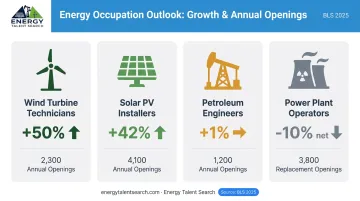
The numbers tell a specific story:
| Occupation | Projected Growth (2024–2034) | Annual Openings |
|---|---|---|
| Wind turbine technicians | +50% | 2,300 |
| Solar PV installers | +42% | 4,100 |
| Petroleum engineers | +1% | 1,200 |
| Power plant operators | -10% (net) | 3,800 (replacement) |
Source: BLS Occupational Outlook Handbook, 2025
Even in occupations with flat or declining net growth, replacement demand still generates thousands of annual openings. These are occupation-specific, geography-specific pressures — each requiring a targeted response.
The Passive Candidate Reality
The majority of highly qualified energy professionals are already employed and not browsing job boards. Traditional postings consistently reach the least experienced or least satisfied segment of the market — not top performers. Reaching the right candidates requires going to where they are, not waiting for them to come to you.
Effective passive candidate outreach typically involves:
- Targeted direct outreach through professional networks and industry communities
- Referrals from trusted contacts already inside a candidate's field
- Recruitment partners with pre-built relationships in niche technical disciplines
- Presence at industry conferences and trade events where top performers gather
The Employer Brand Gap
Oil and gas companies face a specific perception challenge with younger engineering graduates. An EY survey found that only 26% of Gen Z considered oil and gas careers appealing — a gap that's widened as environmental concerns have become more prominent in career decision-making.
Transparency about innovation investments, energy transition commitments, and genuine career paths can shift that perception. It takes deliberate, consistent communication — not broad claims.
Targeted Recruitment Strategies for Energy Companies
Filling technical roles in energy requires more than posting on job boards. The strategies below address where qualified candidates actually are — and how to reach, attract, and secure them before a competitor does.
Prioritize Passive Candidate Sourcing
Because top energy professionals are rarely actively searching, effective recruitment requires proactive outreach: through industry networks, professional associations, conference connections, and specialized recruiting channels.
Partnering with a firm like Energy Talent Search, which specializes in energy sector talent, provides direct access to passive candidates who are invisible on general job boards.
Equally important is sector-specific screening. Evaluating whether a candidate's technical qualifications actually match role requirements demands genuine industry knowledge — not just keyword matching.
Build an Employer Brand That Resonates
Candidates increasingly evaluate employers on purpose and growth opportunity, not compensation alone. Energy companies should clearly communicate:
- Their safety culture and commitment to employee wellbeing
- Career development pathways — not just the current role, but where it leads
- Specific projects, technologies, or energy transition investments underway
- Their role in the broader shift toward cleaner energy systems
This messaging needs to live beyond job postings — on LinkedIn, in conference presence, and in how current employees describe their work publicly.
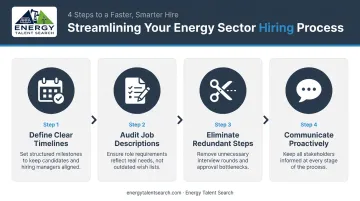
Streamline the Hiring Process
Slow, opaque hiring processes are a significant deterrent in a market where strong candidates receive multiple offers simultaneously. Energy employers should:
- Define clear timelines at the start of each search and communicate them to candidates
- Audit job descriptions for accuracy — vague or inflated requirements filter out qualified candidates and attract misaligned ones
- Eliminate redundant steps that delay decisions without improving candidate quality
- Communicate proactively at every stage, even when the update is just "we're still evaluating"
Build University and Technical Pipeline Relationships
Developing partnerships with engineering schools, trade programs, and energy-focused universities builds a durable pipeline of emerging talent. Internship programs serve as a proving ground for both sides before a full-time commitment is made.
Cross-industry data from NACE shows a 63.1% intern conversion rate and 76.1% one-year retention for former interns — numbers that consistently outperform cold external hires.
Yet NREL's wind workforce assessment found that 58.8% of wind employers were underusing educational institutions as a candidate source. That gap represents one of the lowest-cost, highest-return pipeline opportunities available to energy companies today.
Retention Strategies That Keep Energy Talent Engaged
Offer Competitive and Transparent Compensation
Compensation that was market-rate two years ago may now lag — particularly as technology and finance sectors aggressively recruit the same STEM talent pool. Energy employers should benchmark salaries against current market data regularly, not just at hire.
Transparency matters too. Communicating pay ranges, bonus structures, and benefits clearly during recruitment reduces expectation misalignment and prevents early attrition driven by compensation disappointment after the offer is signed.
Invest in Career Development and Cross-Sector Growth
Lack of advancement opportunity is consistently among the top reasons energy professionals leave — particularly younger ones. Retention-focused development programs include:
- Clear career pathways showing where a role can lead within 2–5 years
- Cross-training between traditional and renewable energy functions, giving employees exposure to emerging areas of the business
- Certifications and continuing education supported by the company, not just encouraged
- Internal mobility programs — lateral moves, project assignments, and leadership tracks that give employees reasons to grow internally rather than looking elsewhere
Foster a Strong Safety Culture as a Retention Driver
In the energy sector, safety culture isn't only a compliance requirement — it's a retention mechanism. Research on mining industry workers found that stronger safety climate was associated with greater job satisfaction and lower turnover intention. Employees who trust that their employer prioritizes their physical wellbeing report stronger organizational commitment — and are far more likely to recommend the organization to peers in their professional networks.

Build Mentorship and Succession Planning Into Operations
Structured mentorship programs serve two functions at once: they transfer technical knowledge from senior professionals nearing retirement to the next generation of specialists, and they improve retention among both mentors and mentees by increasing their sense of value within the organization.
Succession planning extends that logic further. Companies that identify high-potential employees early, map their development paths, and anticipate key departures are far better positioned than those reacting to retirements and resignations after the fact.
The Critical Role of Onboarding in Energy Sector Retention
The first 90 days of employment are among the highest-risk periods for attrition — especially in technical energy roles where new hires may encounter field site complexity, unfamiliar equipment, and steep learning curves.
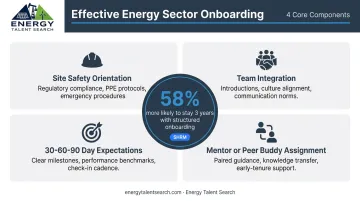
Effective onboarding in energy goes well beyond paperwork and policy review. It should include:
- Site safety orientation specific to the actual work environment
- Team integration — introductions, context, and relationship-building, not just org charts
- Clear 30-60-90 day performance expectations so new hires understand what success looks like and when
- Assignment of a mentor or peer buddy who can provide context and support during the transition
The promises made during recruitment — about culture, growth opportunities, and team environment — must be immediately visible during onboarding. A gap between what was described in interviews and what a new hire experiences in week two is one of the most common and preventable drivers of early resignation.
SHRM reports that employees who complete structured onboarding are 58% more likely to remain for three years. In energy, where onboarding complexity is higher than most industries — spanning safety certifications, site-specific protocols, and technical equipment training — a structured program isn't a nice-to-have. It's a direct line to retention.
Using Data and Analytics to Strengthen Hiring and Retention
Key Recruitment Metrics to Track
- Time to fill — by role type and hiring channel, to identify where bottlenecks accumulate
- Offer acceptance rate — a low rate signals compensation misalignment or process problems
- Source of hire quality — which channels produce candidates who stay and perform
- Early attrition rate — by role and sourcing channel, to identify patterns before they compound
Key Retention Metrics to Monitor
- Voluntary turnover rate by department and tenure — where and when are people leaving?
- Internal promotion rate — are high-potential employees advancing, or leaving to advance elsewhere?
- Exit interview themes — qualitative data is often more revealing than quantitative scores
- Employee engagement scores — ideally tracked longitudinally, not just at annual review cycles
Geospatial and Predictive Analytics
Geospatial talent analytics map where qualified candidates are concentrated by geography, skill set, and career stage. This allows companies and their recruiting partners to pinpoint talent faster and reduce time-to-fill for specialized roles that conventional channels routinely struggle to staff.
Energy Talent Search applies geospatial analytics to surface passive candidates in targeted markets — a capability that matters most given how concentrated energy talent is across particular basins, corridors, and emerging renewable hubs across the U.S.
Frequently Asked Questions
What is recruitment and retention?
Recruitment is the process of attracting, screening, and hiring qualified candidates. Retention refers to the strategies an organization uses to keep employees engaged and employed long-term. Both work together to build a stable, high-performing workforce — and gaps in either drive up turnover costs.
What is the role of recruitment in retention?
Recruitment sets the foundation for retention. When companies hire candidates who genuinely fit the role, team, and culture, those employees are far more likely to stay long-term. Misaligned hires driven by urgency or inaccurate job descriptions produce early attrition, increasing time-to-fill and cost-per-hire.
What are the 5 C's of retention?
The 5 C's are Compensation, Culture, Career development, Communication, and Camaraderie (or Connection). Effective retention programs address all five dimensions — not just pay.
What are the 3 R's of employee retention?
The 3 R's are Respect, Recognition, and Reward — covering how employees are treated daily, whether their contributions are acknowledged, and whether compensation and benefits reflect their value.
What are the biggest recruitment challenges in the energy sector?
Energy employers face a shortage of specialized technical professionals, a large passive candidate pool invisible to conventional job posting, geographic constraints, and increasing competition from technology and finance for engineering and data talent. The DOE's 2025 USEER found that 95% of onshore-petroleum construction employers reported at least some hiring difficulty.
How can energy companies compete with tech companies for engineering and data talent?
Energy employers can compete by emphasizing mission-driven work, career stability, competitive compensation, and meaningful impact on infrastructure and the energy transition. Employer branding that highlights innovation, cross-sector growth, and the real-world scale of energy projects resonates strongly with younger engineers — often more than salary alone.