The pressure points driving this shift are real. Project cycles in oil and gas rarely align with permanent headcount plans. The energy transition is creating demand for skill sets that don't exist inside most existing teams. The U.S. Department of Energy's 2025 Energy & Employment Report found that 94% of utilities employers experienced at least some hiring difficulty in 2024, with a third calling it very difficult. Upstream and field-based roles face similar constraints.
This guide breaks down how contingent staffing works in the energy sector, where it applies, how to run the process well, and where energy employers most commonly go wrong.
Key Takeaways
- Contingent staffing lets energy employers scale technical workforces around project timelines, commodity cycles, or regulatory deadlines — no permanent hiring costs required
- Common contingent worker types include contract engineers, field technicians, HSE officers, environmental compliance specialists, and project managers
- Successful engagements require a clearly scoped role, a sector-specialized staffing partner, and defined onboarding and offboarding protocols
- Misclassification, skipped credential verification, and indefinite renewals without reassessment are the most common and costly mistakes
What Is Contingent Staffing?
Contingent staffing is a workforce model in which companies engage workers on a temporary, contract, or project basis rather than as permanent employees. Workers are compensated for the duration of the engagement and are not entitled to the same employer-provided benefits as full-time staff.
Worker Types in the Energy Context
The umbrella term covers several distinct arrangements, and the distinctions matter legally and operationally:
- Independent contractors: Self-employed individuals hired for defined deliverables; classification follows IRS behavioral control, financial control, and relationship tests
- Staffing agency-placed workers: Employed by the agency, assigned to the host energy company for a defined period
- Project-based consultants: Engaged for a specific scope of work with defined outputs and a set end date
- Interim specialists: Experienced practitioners brought in to fill a skills gap or cover a departing employee for a fixed term
Each carries different legal, tax, and co-employment implications. A contract label alone does not determine the correct classification. Both the IRS and the Department of Labor apply substance-over-form tests, meaning the actual working relationship determines classification, not what the contract says.
Contingent Staffing vs. Direct Hire
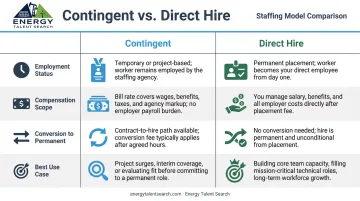
These two models differ across several dimensions energy employers need to weigh:
| Contingent | Direct Hire | |
|---|---|---|
| Employment status | Temporary, contract, or project-based | Permanent employee from day one |
| Compensation scope | Ends when the engagement closes | Ongoing salary and benefits |
| Conversion to permanent | Possible, but not the default | Not applicable |
| Best for | Defined projects, seasonal demand, skills gaps | Long-term team building and core roles |
Why Energy Companies Rely on Contingent Staffing
The Project-Based Nature of Energy Work
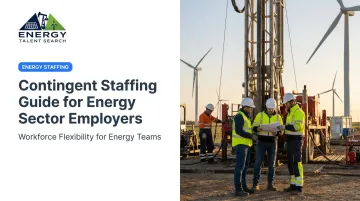
Drilling campaigns, pipeline construction phases, plant turnarounds, and renewable energy site builds all share a common feature: they have a start, a defined scope, and an end. Hiring permanent employees for work that will conclude in six months creates structural mismatches between labor cost and labor need.
Contingent staffing resolves this. A completion crew, a turnaround maintenance team, or a solar installation cohort can be engaged for exactly the period required and released when the project closes. Neste's 2024 Porvoo refinery turnaround illustrates the scale this can reach — roughly 4,500 people, including workers from more than 100 audited contractor companies, over approximately nine weeks.
Commodity Price Volatility
By August 2020, U.S. oilfield services and equipment had lost more than 100,000 jobs — a direct result of the price collapse that arrived with almost no warning.
Companies that maintain lean permanent headcount and rely on a contingent workforce layer can respond to price compression without restructuring their entire organization.
The Energy Transition Skills Gap
Moving from fossil fuel operations to renewables requires skill sets that most existing permanent teams don't have. BLS projects wind turbine technician employment will grow 50% by 2034 and solar PV installer employment by 42% — from a base that's already tight.
Contingent specialists cover the critical gap while permanent teams develop. Key roles employers are sourcing on a project basis include:
- Grid modernization engineers and technicians
- Battery storage integration specialists
- Renewable site construction supervisors and safety leads
Aging Workforce and Knowledge Retention
BLS data shows median ages of 43.1 years in support activities for mining and 44.9 years in utilities. The IEA flags a sharper problem in specific occupations — nuclear and grid roles show retirement entrants outpacing new entrants at ratios above 1.4:1. Experienced contractors and retirees returning to project-based work allow companies to retain operating and engineering knowledge for critical assignments while permanent succession planning catches up.
Regulatory and Outage Deadlines
Environmental permitting cycles, OSHA-driven project requirements, and planned outage windows create hard deadlines that can't wait for traditional hiring timelines. A plant turnaround scheduled for Q2 needs its inspection, instrumentation, and safety crews confirmed well before the shutdown date. Contingent models — with their faster deployment capability — are a better structural fit for these scenarios than a 90-day permanent hiring process.
How the Contingent Staffing Process Works in the Energy Sector
Most failed contingent engagements trace back to vague scoping, poor partner selection, or weak onboarding. The process itself is straightforward when followed deliberately.
Step 1: Define the Engagement
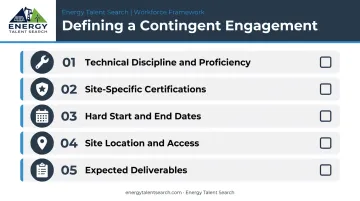
Before approaching any staffing partner, the employer should document:
- Technical discipline, experience level, and required software or equipment proficiency
- Site-specific certifications — OSHA 10/30, H2S awareness, confined space entry under 29 CFR 1910.146, or any asset-specific credentials
- Hard start and end dates, or a milestone-based project timeline
- Site location — especially important for remote or fly-in/fly-out assignments
- Expected deliverables — what the engagement should produce, not just what the person should do
Vague briefs produce poor matches. A job description that says "experienced engineer" without specifying reservoir vs. process vs. instrumentation will generate a shortlist that wastes everyone's time.
Step 2: Source and Screen Candidates
A specialized energy staffing partner draws on an existing network of both active and passive candidates — professionals not currently job-searching but open to the right opportunity. For technical roles like reservoir engineers, HSE officers, field inspectors, or process technicians, that network is the asset. A generalist agency filling an oil and gas instrumentation role by keyword match is a fundamentally different exercise than a recruiter who has placed three instrumentation specialists in the past year.
Energy Talent Search focuses specifically on oil and gas, renewables, mining, and manufacturing — meaning the recruiters handling energy contingent searches understand what makes a qualified candidate for a technical field role, not just what the job title says. That sector depth translates directly into faster, more accurate shortlists.
Thorough screening covers technical qualification review, culture-fit assessment relative to the host site, and verification of all required safety credentials before a candidate is presented.
Step 3: Onboard, Manage, and Offboard
Short-term engagements still require structured onboarding. At minimum, a contingent worker starting an energy assignment needs:
- Site-specific safety protocol orientation
- System and equipment access provisioning
- Clear role expectations and deliverable milestones
- Named contact for questions and issue escalation
Offboarding deserves equal attention. When the engagement ends, access revocation, knowledge transfer documentation, and a formal close-out process reduce both compliance exposure and operational gaps. Leaving a former contractor with active system credentials or no documented handoff is one of the most common — and avoidable — compliance risks in contingent energy work.
Where Energy Sector Employers Apply Contingent Staffing
Application Areas by Segment
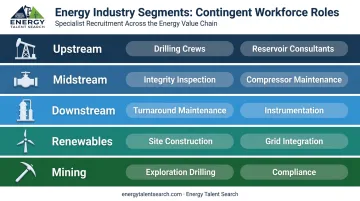
| Segment | Common Contingent Use Cases |
|---|---|
| Upstream | Drilling crews, completion specialists, well servicing, reservoir consultants |
| Midstream | Pipeline construction, compressor station maintenance, integrity inspection |
| Downstream | Plant turnarounds, outage maintenance, process and instrumentation work |
| Renewables | Wind farm construction, solar installation, grid integration, battery storage commissioning |
| Mining | Exploration drilling, processing operations, environmental compliance |
Calendar-Based vs. Condition-Based Staffing
Some contingent needs are predictable. Annual plant turnarounds, seasonal construction windows, and recurring regulatory inspection cycles follow set calendars. Employers who treat these as surprises each year lose time and pay premium rates for late sourcing.
Others are condition-based: commodity price recovery, regulatory approval, or project financing closing triggers the workforce need. Both require planning, but the approach looks different.
Functional Roles Most Commonly Placed
Contingent arrangements in the energy sector span a wide range of technical and operational functions. Roles commonly placed include:
- Project engineers and engineering operations specialists
- HSE and safety officers
- Environmental compliance and permitting specialists
- Geologists and geophysicists
- Field technicians and maintenance personnel
- Accounting and finance contractors supporting capital project budgets
- Project managers across upstream, midstream, and renewable deployments
Common Mistakes and When Contingent Staffing May Not Be the Right Fit
The Most Frequent Mistakes
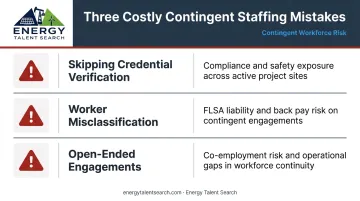
Failing to verify certifications before deployment. OSHA's 10-hour and 30-hour Outreach courses are voluntary programs — they don't satisfy standard-specific requirements for confined space entry, H2S exposure control, or respiratory protection. An Outreach card is not universal clearance. Verify the exact certification required for the specific hazard and site before the worker steps on location.
Misclassifying workers. The label on a contract doesn't determine classification — the actual working relationship does. The DOL's economic dependence analysis and the IRS's behavioral and financial control tests both examine how the relationship operates day to day. A worker under direct supervision, working set hours, integrated into company workflows is a likely employee regardless of what the paperwork says. Misclassification strips workers of minimum wage, overtime, and FLSA protections — and leaves the company holding the liability.
Leaving engagements open-ended without review. No formal offboarding, no knowledge transfer, access credentials still active three months after the project ended — these gaps create real operational and compliance exposure. The longer they go unaddressed, the harder they are to untangle.
When Contingent Staffing Isn't the Right Answer
Contingent staffing carries real costs: day rates, agency margins, onboarding time, and productivity ramp-up on each engagement. For roles requiring deep institutional knowledge, multi-year project tenure, or significant orientation investment, the total cost of repeated contingent placements can exceed a direct hire.
Watch for these signals that contingent is being used by default rather than by design:
- The same worker has been renewed multiple times without any formal reassessment
- No clear project endpoint exists or was ever defined
- The role has evolved into a permanent organizational function
When these signals appear, a direct hire or temp-to-hire conversion is usually the more cost-effective path — and often the lower-risk one. A temp-to-hire arrangement in particular lets you evaluate fit before committing, without extending an open-ended contingent engagement indefinitely.
Frequently Asked Questions
What is contingent staffing?
Contingent staffing is the practice of hiring workers on a temporary, contract, or project basis rather than as permanent employees. Companies use it to access specific skills for defined periods without long-term employment commitments.
What markup or fee should energy companies expect when using a contingent staffing agency?
Markup rates for contingent energy workers typically range from 40% to 60% above the worker's bill rate, covering agency overhead, employer taxes, and administrative costs. Specialized roles — drilling supervisors, HSE officers, environmental compliance specialists — often carry higher markups reflecting the difficulty of sourcing qualified candidates.
What types of roles in the energy sector are most commonly filled through contingent staffing?
Common energy contingent roles include project engineers, HSE officers, environmental compliance specialists, field technicians, geologists, drilling supervisors, landmen, and accounting and finance contractors supporting capital project budgets.
How does contingent staffing differ from direct hire in the energy industry?
Direct hire places a candidate as a permanent full-time employee from day one. Contingent staffing engages workers for a defined project or period. Contingent arrangements can convert to permanent employment if the fit is strong, but that outcome requires a deliberate decision; it isn't automatic.
What compliance requirements should energy companies consider when hiring contingent workers?
The primary considerations are worker classification (contractor vs. employee under IRS and DOL tests) and verification of site-specific safety certifications for the role and hazard exposure. Co-employment liability is also a key concern, particularly when a host company exercises direct control over a staffing agency-placed worker.
How long can an energy company keep a contingent worker on assignment?
There is no universal legal limit, but most organizations set internal guidelines (typically 12 to 24 months) after which the role should be formally reassessed. Extended engagements without review can create co-employment risk and may signal that a direct hire is the more appropriate structure.