
Introduction
Picture this: your offshore drilling campaign kicks off in six weeks, project approval just came through, and your internal HR team is already stretched thin supporting three other active sites. You need 40 qualified field professionals—fast—and a standard permanent hiring process won't get you there.
That's where contingent hiring earns its place.
Across oil and gas, renewables, mining, and energy construction, contingent workforce strategies have become a standard tool for managing project-driven labor demands. When commodity prices shift or a utility-scale solar build accelerates its timeline, the ability to scale headcount quickly—without adding permanent payroll obligations—is a genuine competitive advantage.
This guide covers what energy hiring managers need to know—from worker classifications and compliance risks to building a strategy that holds up under project pressure.
Key Takeaways:
- Contingent hiring lets energy companies scale workforces around project timelines without permanent headcount commitments
- The energy sector's boom-bust cycles and niche technical demands make this model especially practical
- Worker misclassification and safety certification gaps are the two most significant compliance risks
- Specialized recruitment partners cut time-to-fill compared to generalist agencies
- Contingent placements offer a structured trial period before committing to permanent hires
What Is Contingent Hiring in the Energy Sector?
Contingent hiring means engaging workers on a non-permanent basis—tied to specific projects, timeframes, or seasonal demand spikes—rather than bringing them on as full-time employees. The arrangement ends when the project wraps, the season closes, or the defined scope is complete.
According to the Bureau of Labor Statistics' 2023 Contingent and Alternative Employment Arrangements report, 6.9 million U.S. workers (4.3% of total employment) held contingent jobs as their sole or main position. In construction—a close proxy for energy project work—independent contractors alone represented 18.5% of the workforce.
How Contingent Hiring Differs from Traditional Hiring
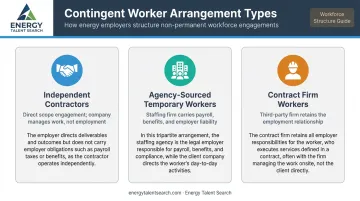
Contingent workers are not on your permanent payroll. They typically don't receive standard company benefits, and the engagement is defined by contract rather than ongoing employment. Three distinct arrangements cover most energy contexts:
- Independent contractors — engaged directly under a defined scope; you manage the work, not the worker's employment status
- Agency-sourced temporary workers — placed through a staffing firm, which carries payroll, benefits, and employer liability
- Contract firm workers — employees of a third-party firm assigned to your worksite, with that firm retaining the employment relationship
Why Energy Is Particularly Well-Suited to This Model
The energy sector runs on project cycles. Drilling campaigns, refinery turnarounds, pipeline inspections, and solar farm construction phases all have defined start and end dates. Roles tied to these phases often last four to six months—long enough to require skilled professionals, short enough that permanent headcount doesn't make financial sense. Contingent hiring gives you the workforce flexibility to scale up for the work and step back when it's done, without carrying idle labor costs between projects.
Types of Contingent Workers Energy Companies Use
Core Categories in Energy Contexts
Energy employers draw on three main pools of contingent talent:
- Contract engineers and technical specialists — petroleum engineers, process engineers, SCADA technicians, and field inspectors engaged for specific project phases
- Temporary field workers — pipefitters, welders, electricians, boilermakers, and solar installers brought on during construction or turnaround periods
- Independent consultants — HSE advisors, project managers, geologists, and environmental compliance specialists engaged for expertise-driven scopes
Reuters' reporting on refinery turnarounds illustrates this clearly: a single two-month turnaround at one Ohio refinery drew an estimated 2,000–3,000 workers, with the overwhelming majority sourced through contractors on a contingent basis rather than drawn from permanent union labor.
The Staffing Agency Route
Filling that volume of specialized roles quickly isn't something most HR teams can handle alone. That's why many energy companies work with sector-specific recruitment agencies—particularly for roles where safety certifications and specialized licenses are non-negotiable. Pre-screened candidates arrive with verified credentials, which reduces onboarding risk and shortens the time between assignment and productive work on site.
Energy Talent Search, for example, verifies certifications, reviews safety records, and conducts technical competency assessments before presenting candidates—so energy clients aren't sorting through unvetted applicants during a tight project ramp-up.
Emerging Sub-Sectors Driving New Demand
The DOE's 2025 U.S. Energy & Employment Report counted 370,600 solar workers, 133,000 wind workers, and 78,800 battery storage workers in 2024. Solar employers projected 9.8% employment growth through 2025, with battery storage at 10.1%. Much of this growth runs through project-based construction work—the environment where contingent labor is most practical.
Carbon capture, hydrogen infrastructure, and offshore wind are seeing similar demand patterns, often in roles where no established internal talent pipeline yet exists.
Why Energy Companies Are Embracing Contingent Hiring
Workforce Scalability Around Project Lifecycles
Energy projects don't run on a consistent 12-month cycle. An offshore rig requires a full crew during active drilling and a skeleton team during maintenance. A utility-scale solar build needs hundreds of installers during construction and a fraction of that for operations.
Maintaining a permanent workforce sized for peak demand is financially unsustainable. Contingent hiring lets companies treat labor as a variable cost—scaling up when a project demands it, scaling back when it doesn't.
Access to Niche Technical Talent
Many of the most critical energy roles—well completion engineers, rotating equipment specialists, NDT inspectors—are scarce. The DOE report found that 89% of transmission, distribution, and storage construction employers reported difficulty hiring in 2024, with 49% citing insufficient experience or technical skills as the primary reason.
Contingent hiring expands the accessible talent pool. Experienced professionals who prefer project-to-project work—and wouldn't respond to a standard permanent job posting—can be reached through targeted contingent recruitment.
Cost Management During Price Cycles
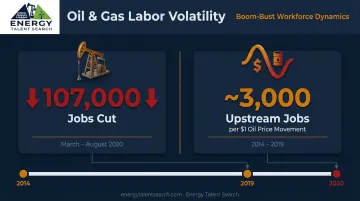
The boom-bust nature of oil and gas pricing creates a structural problem for workforce planning. Deloitte's research found that the U.S. oil, gas, and chemicals industry cut 107,000 jobs between March and August 2020 alone—and estimated that a $1 oil price movement potentially affected 3,000 upstream and oilfield services jobs during 2014–2019.
A variable labor model reduces that exposure meaningfully. Contingent workers can be released when a project concludes without the severance, redeployment, and morale costs associated with laying off permanent staff.
Speed to Productivity and Trial-to-Hire Potential
Contingent placements through specialized energy recruiters can often be filled in days to weeks, which matters when a project timeline allows no room for a slow hiring cycle. The speed advantage alone makes contingent hiring worth considering for time-sensitive builds and turnarounds.
The trial-to-hire dimension adds further value:
- Evaluate technical competence before extending a permanent offer
- Assess safety culture fit in actual field conditions, not just an interview
- Reduce the cost of a mismatched hire in high-stakes operating environments
Contingent Workers vs. Full-Time Employees: When to Choose Which
When to Use Contingent Workers
| Scenario | Contingent Worker Fit |
|---|---|
| Role exists only for a specific project phase | ✅ Strong fit |
| Niche skill needed short-term (e.g., NDT inspector for one campaign) | ✅ Strong fit |
| Fast scaling needed without headcount approval delays | ✅ Strong fit |
| Evaluating a candidate before a permanent offer | ✅ Strong fit |
Contingent workers are the right choice when the work is time-bound, the skill set is specialized but not needed long-term, or when budget constraints favor variable over fixed labor costs.
When to Use Full-Time Employees
Some roles simply don't work on a contingent basis:
- HSE and compliance roles — managers, compliance officers, and plant operations supervisors need deep familiarity with site-specific protocols, regulatory history, and internal culture that a rotating contractor can't realistically build
- Roles with access to sensitive data — reservoir findings, exploration results, and long-range capital plans carry confidentiality expectations that are better enforced through full-time employment agreements
- Safety culture leadership — consistent organizational presence matters here; rotating contingent engagements make it difficult to build the trust and behavioral norms that strong safety cultures depend on
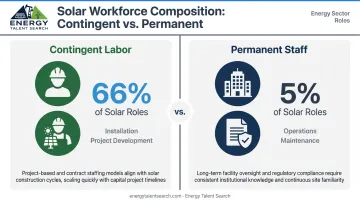
The most effective workforce strategies use both models deliberately. NREL's solar workforce data illustrates this balance: installation and project development account for 66% of solar workforce roles, making them a natural fit for contingent labor. Operations and maintenance, at just 5%, represents the stable core that demands permanent staff.
How to Build a Contingent Hiring Strategy for Energy
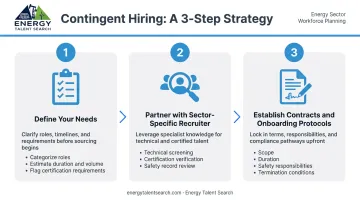
Step 1: Define Your Needs Before You Post Anything
Before reaching out to any agency, categorize which roles across upcoming projects are genuinely suited to contingent engagement:
- Estimate duration and volume by project phase
- Identify which roles require agency sourcing vs. direct contractor engagement
- Flag any roles requiring specific certifications or licenses that need pre-verification
Step 2: Partner with a Sector-Specific Recruitment Firm
Generalist staffing agencies lack the technical screening capability that energy roles demand. A recruiter who doesn't understand the difference between a completion engineer and a production engineer will send you unqualified candidates, wasting time you don't have on a live project.
Working with a firm like Energy Talent Search — which specializes in sourcing active and passive candidates across oil and gas, renewables, mining, and adjacent fields — compresses time-to-fill because technical assessments, certification verification, and safety record reviews happen before a candidate ever reaches your desk.
Step 3: Establish Clear Contracts and Onboarding Protocols
Every contingent engagement should have documented agreements covering:
- Scope and deliverables
- Assignment duration and extension conditions
- Safety compliance expectations and site-specific requirements
- Termination conditions
OSHA's Temporary Worker Initiative is direct on this point: staffing agencies and host employers are jointly responsible for maintaining a safe work environment. The agency typically handles general safety training; the host employer provides worksite-specific hazard training. Define these responsibilities in your contract before a worker steps on site.
Compliance and Risk Considerations for Contingent Hiring in Energy
Worker Misclassification
Misclassifying an employee as an independent contractor creates serious legal exposure. The IRS uses a three-category analysis—behavioral control, financial control, and type of relationship—to assess proper classification.
The exposure is significant: the DOL recovered more than $1.6 million in back wages and liquidated damages for 188 workers misclassified by a single North Carolina construction contractor.
Classification rules are actively shifting. The DOL issued new enforcement guidance in May 2025 directing investigators to apply longstanding economic-realities principles rather than the 2024 rule's analysis, and a proposed rulemaking published in February 2026 would further revise the framework. Work with legal counsel to stay current.
Safety and Certification Verification
In energy environments, contingent workers must meet identical safety standards to permanent employees. Hiring companies must verify credentials regardless of sourcing method. Key requirements to verify:
- OSHA compliance training (site-specific, not just the voluntary 10/30-hour outreach cards)
- H2S safety training per ANSI/ASSP Z390.1 for applicable sites
- API Individual Certification Program credentials for inspection roles
- TWIC credentials for maritime and offshore facility access
Co-Employment and Duration Risk
No federal law imposes a maximum contingent assignment duration for ordinary private-sector engagements. Many organizations set internal guidelines—commonly 12–18 months—to reduce co-employment exposure. Littler Mendelson's analysis is clear, though: internal term limits don't prevent joint-employer liability. What actually matters is the degree of control exercised and the facts of the working relationship.
The practical risk factors that draw scrutiny include:
- Day-to-day supervision by the hiring company's own managers
- Integration into permanent team workflows, systems, or org charts
- Assignments that expand well beyond their original defined scope
Consult your legal and HR advisors before setting internal tenure policies, and audit extended engagements regularly. Getting the classification and control structure right from day one is far easier than unwinding a co-employment claim after the fact.
Frequently Asked Questions
What does contingent hiring mean?
Contingent hiring refers to engaging workers on a non-permanent basis—such as contractors, temporary staff, or freelancers—for roles tied to specific projects, timeframes, or variable workforce demands rather than as full-time employees. The engagement ends when the defined scope concludes.
How long can you keep a contingent worker?
No blanket federal maximum applies to private-sector contingent assignments. Many organizations set internal guidelines of 12–18 months to manage co-employment risk, but tenure alone doesn't determine legal exposure—the facts of the working relationship do. Consult legal counsel for guidance specific to your situation.
What types of contingent workers are most common in the energy sector?
Contract engineers, temporary field workers (welders, pipefitters, electricians, boilermakers), HSE consultants, and project-based technical specialists are the most frequently used categories. Refinery turnarounds, offshore campaigns, and large-scale renewable construction drive the highest contingent demand.
When should an energy company use contingent workers instead of full-time hires?
Contingent workers fit best when a role exists for a defined project phase, when a specialized skill set isn't needed beyond one assignment, or when rapid workforce scaling is required without increasing permanent headcount. Full-time hires make more sense for continuous operational and safety leadership roles.
What are the main compliance risks of contingent hiring in energy?
Worker misclassification, co-employment liability, and failure to verify safety certifications are the primary risks. Proper contracts, clear documentation, and legal counsel are essential given ongoing regulatory changes to independent contractor classification rules.
Can contingent workers in energy transition to permanent roles?
Yes. Many energy companies treat contingent placements as an extended evaluation period, converting strong performers to full-time roles. For technical positions especially, a working trial reveals fit far more reliably than an interview alone.