Introduction
Filling a specialized energy role has never been straightforward — but the current talent landscape makes it genuinely consequential. The energy transition is creating simultaneous demand for traditional oil and gas expertise and emerging renewable skills, while an aging workforce accelerates succession gaps across the industry.
The scale of the pressure is documented. According to the 2025 U.S. Energy & Employment Report, 91% of fuels manufacturing employers reported at least some difficulty finding qualified workers, with inadequate technical skills and insufficient qualifications cited as the leading barriers. The IEA reports that qualified new entrants must increase 40% by 2030 just to prevent the skills gap from widening further.
Against that backdrop, choosing between direct hiring and agency recruiting is a strategic decision with real consequences. Direct hiring means your internal HR team owns the full recruitment cycle. Agency recruiting means partnering with a specialized firm that sources, screens, and delivers candidates. The right choice depends on the role, your internal capacity, and how fast you need to move.
Key Takeaways
- Direct hiring performs best when applicant flow is consistent and your internal team has genuine energy sector knowledge
- Agency recruiting delivers stronger outcomes for technical, leadership, and passive-candidate-dependent roles
- SHRM's 2025 benchmarks put average cost-per-hire at $5,475 for nonexecutive roles and $35,879 for executives, not counting vacancy duration or bad-hire turnover costs
- Technical screening for roles like HSE managers and renewables project leads demands energy-specific expertise most HR generalists don't have
- Many energy companies run a blended model: direct hire for entry-level volume, agency recruiting for specialized and leadership positions
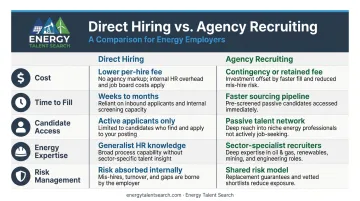
Direct Hiring vs. Agency Recruiting: Quick Comparison
| Factor | Direct Hiring | Agency Recruiting |
|---|---|---|
| Cost | Internal HR time, job board fees, ad spend; no placement fee | ~20% of first-year salary on successful hire (per SIA benchmarks) |
| Time to Fill | Longer for specialized roles; depends on applicant volume | Faster for niche roles; pre-screened pipelines already in place |
| Candidate Access | Active job seekers who find and apply to your posting | Includes passive candidates not browsing job boards |
| Energy Expertise | Screening depth limited by your internal team's technical knowledge | Recruiters vet for certifications, safety credentials, and technical fit |
| Risk Management | Organization absorbs full cost of a mis-hire or early departure | Reputable agencies offer replacement guarantees at no additional fee |
What Is Direct Hiring for Energy Companies?
Your internal HR team or hiring manager owns the full recruitment cycle — job descriptions, postings, application screening, interviews, and offers. No third-party intermediary, no placement fee.
Where Direct Hiring Works
The core appeal is control and cost savings. When your team has the capacity, industry expertise, and consistent applicant flow to execute the process well, direct hiring makes financial sense. It works best for:
- Administrative and support roles with reliable applicant volume
- Entry-level field technicians in high-population energy markets
- Repeatable positions where your team has calibrated what "qualified" looks like
- Companies with a dedicated internal recruiting function that carries genuine energy sector knowledge
Where Direct Hiring Breaks Down
For most energy-specific positions, the core limitation is technical screening. HR generalists are not typically equipped to evaluate candidates for upstream operations, grid infrastructure, renewables project management, or EPC contracting roles.
A resume with the right keywords isn't the same as a candidate who holds the right certifications, has worked the right project types, and understands the safety environment they're stepping into.
SHRM's 2025 benchmarking data puts average cost-per-hire at $5,475 for nonexecutive roles — and that's before accounting for how long a safety-critical or project-leadership role sits vacant. In energy, extended vacancies don't just create HR headaches. They delay project timelines, create compliance exposure, and pull operations leaders away from their actual work.
Beyond screening gaps and vacancy costs, direct hiring relies on inbound applicants. That's a hard constraint when the candidates you need aren't actively looking:
- Passive candidates in niche technical roles rarely respond to job postings
- Senior field or project talent is often placed through referral networks, not applications
- High-demand specializations — grid engineers, HSE managers, EPC project leads — require proactive outreach to surface
What Is Agency Recruiting for Energy Companies?
A specialized recruitment firm handles sourcing, screening, and candidate presentation on your behalf. You pay a placement fee on a successful hire; the agency absorbs the time, expertise, and risk of finding a qualified match.
The Passive Candidate Advantage
The most experienced petroleum engineers and operations managers with strong safety credentials are rarely browsing job boards. They're employed, performing well, and not actively looking — but they're open to the right conversation.
Energy Talent Search, a Denver-based recruitment agency specializing in oil and gas, renewable energy, mining, and manufacturing, builds ongoing relationships with exactly these professionals. Their passive candidate sourcing approach — headhunting technical and executive talent rather than waiting for inbound applications — reaches a segment of the workforce that standard postings can't reach.
According to Gallup's 2025 research, 51% of U.S. employees are watching for or actively open to new opportunities even when they're not applying. Agency outreach is uniquely positioned to access that pool.
Screening Depth for Technical Roles
Energy agencies screen for role-specific requirements before a candidate reaches the interview stage: API certifications, OSHA credentials, relevant software proficiency, and project-type experience. That pre-qualification keeps unqualified candidates off your operations team's calendar.
When Agency Recruiting Works Best
- Senior engineers, HSE managers, and project executives where a wrong hire creates downstream safety and compliance risk
- Renewables specialists whose skill sets are scarce and actively competed for across the market
- Roles that have been open for weeks without viable inbound applicants
- Hiring in remote or niche energy markets — Permian Basin operations, Rocky Mountain energy projects, offshore Gulf Coast positions — where local applicant flow is thin
- Situations where internal HR capacity is stretched or the team lacks the technical depth to screen effectively
Energy Talent Search backs every placement with a replacement guarantee — if the hire doesn't work within an agreed window, the search runs again at no additional cost. It's a safeguard that internal hiring simply can't offer.
Which Approach Is Better for Energy Companies?
The right approach depends on the specific role, how urgently it needs to be filled, and whether the ideal candidate is actively searching or quietly employed somewhere else. Company size rarely settles the question — role type and talent availability do.
The Energy Sector's Dual Talent Challenge
The industry is navigating two pressures simultaneously. In traditional oil and gas, the IEA reports 2.4 workers nearing retirement for every entrant under 25 in advanced-economy energy sectors — a succession gap that direct hiring pipelines weren't built to address. At the same time, renewable energy expansion is creating fierce competition for a scarce pool of professionals with both technical credentials and sector experience.
The BLS outlook makes the divergence concrete:
| Role | 2024–2034 Growth | Annual Openings |
|---|---|---|
| Petroleum engineers | 1% | ~1,200 |
| Wind turbine technicians | 50% | ~2,300 |
| Solar PV installers | 42% | ~4,100 |
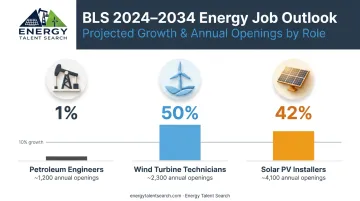
Both traditional and renewable roles face talent scarcity — just for different reasons. Petroleum engineer openings are modest in number but extremely competitive because the candidate pool is narrow and specialized. Wind and solar roles are growing fast enough that demand outpaces the available trained workforce.
Situational Guidance
Choose direct hiring when:
- The role is entry-level or administrative with predictable applicant flow
- Your internal team has genuine energy sector knowledge (not just general HR expertise)
- Timeline pressure is low and the position doesn't carry safety-critical accountability
- You're hiring at volume for a repeatable role type
Choose agency recruiting when:
- The role is technical, leadership-level, or requires specialized certifications
- The position has been posted for several weeks without a viable candidate
- You need to reach passive candidates — employed professionals not actively searching
- Your internal team lacks the capacity or technical depth to screen effectively
- The operational, financial, or safety cost of a wrong hire outweighs the placement fee
The Blended Model
Most energy companies find the most traction by splitting the two approaches by role type rather than picking one across the board. Direct hire handles stable, entry-level, and high-volume positions where inbound applicant flow is reliable.
Agency recruiting covers specialized, leadership, and project-critical roles where the stakes of a vacancy or mis-hire are too high to leave to chance. This keeps internal costs controlled while protecting quality on the hires that carry the most operational and strategic weight.
Conclusion
Direct hiring works well when your internal team has the capacity, the energy sector knowledge, and the applicant pipeline to execute it properly. Agency recruiting delivers its clearest value when the role is specialized, the right candidate is passively employed, or the cost of getting it wrong — operationally, financially, or from a safety standpoint — exceeds what a placement fee represents.
For energy companies managing a shrinking traditional workforce, rapid renewable growth, and increasingly complex role requirements, the real question isn't cost — it's which model gives you the best chance of hiring the right person before the gap becomes a problem.
Partnering with a firm that knows energy specifically — not just hiring in general — changes what's possible. Energy Talent Search works with oil and gas, renewable energy, mining, and manufacturing companies to place technical and leadership candidates that in-house searches typically can't reach, including passive talent in niche roles. If your team is navigating a hard-to-fill role or a search that's stalled, reach out to discuss your current hiring challenges.
Frequently Asked Questions
Which is better, direct hire or agency?
Neither is universally superior — the right choice depends on the role's complexity, urgency, and whether the right candidate is actively looking. For specialized energy positions or any role where passive candidate access is critical, agency recruiting consistently produces faster, better-quality outcomes.
Is it easier to get hired through a staffing agency?
For mid-to-senior level professionals, working with a specialized energy recruiter opens access to roles that are never publicly posted and provides an advocate who understands the industry. That's a meaningful advantage in a sector where many of the best opportunities are never publicly listed.
How much does agency recruiting cost for energy companies?
Placement fees are structured as a percentage of the hired candidate's first-year salary. Industry-standard rates typically run around 20%. Weigh that fee against the full cost of a prolonged vacancy, a bad hire, and the internal HR time direct hiring demands.
What types of energy roles benefit most from agency recruiting?
Technical, leadership, and certification-dependent roles benefit most: petroleum engineers, HSE managers, renewables project leads, operations managers, and executive positions. These roles require specialized screening and access to passive candidates that standard job boards can't reach.
How long does it take to fill an energy sector role through an agency versus direct hiring?
Agency recruiting typically reduces time-to-fill for specialized roles because agencies maintain pre-screened candidate pipelines and actively source passive professionals. Direct hiring timelines depend on inbound applicant volume, which is a real limitation for niche technical positions where few candidates are actively searching.