
Introduction
Energy sector hiring has never been more competitive. The U.S. employed 8.35 million energy workers in 2023 — and according to the U.S. Department of Energy's 2024 Energy Employment Report, 76% of energy employers reported at least some hiring difficulty that year. In fuels construction, that figure hit 98%.
The real difficulty is specificity. Petroleum engineers, SCADA technicians, reservoir geoscientists, and renewable energy specialists rarely surface through a generic Indeed post. The most capable candidates are typically passive — currently employed and unreachable through standard channels.
Energy employers who rely on broad-market tools often end up with high applicant volumes and low placement quality. The sector demands recruiting solutions built for its realities: specialized agencies, niche job boards, and ATS platforms designed to handle complex technical pipelines.
This guide covers five of the best recruiting solutions available to energy employers today, what makes each one effective, and how to choose the right fit.
Key Takeaways
- 76% of U.S. energy employers reported hiring difficulty in 2024 — generic platforms rarely fill specialized roles effectively.
- The most skilled energy professionals aren't on job boards — passive candidate access is essential.
- Specialized agencies like Energy Talent Search are best for niche, technical, or executive roles.
- Job boards like Rigzone reach active energy candidates; LinkedIn Talent Solutions reaches passive ones.
- ATS platforms (Greenhouse, Workable) manage pipeline efficiently but don't substitute for active sourcing.
Overview of Recruiting Solutions in the Energy Sector
"Recruiting solutions" for energy employers spans three distinct categories: specialized staffing agencies, industry-specific job boards, and applicant tracking systems (ATS). No single tool covers all hiring needs, particularly in a sector as diverse as energy, which spans oil and gas, renewables, mining, manufacturing, and construction.
Each category serves a different function:
- Specialized agencies source candidates proactively, including passive professionals not visible on any platform
- Job boards attract active candidates already searching within the sector
- ATS platforms organize, screen, and track candidates once they're in your pipeline
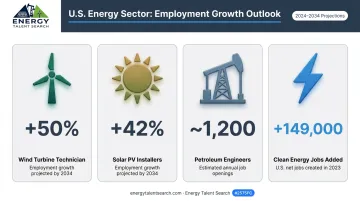
The talent pressure is real across subsectors. BLS projections show wind turbine technician employment growing 50% by 2034, solar PV installers up 42%, and petroleum engineering producing just 1,200 average annual openings — a narrow pipeline for a high-demand role.
Clean energy alone added 149,000 jobs in 2023, widening the gap between employer demand and available candidates.
The five options below were selected based on their demonstrated ability to serve energy employers across specialization, candidate access, and pipeline management.
Best Recruiting Solutions for Energy Sector Employers
These solutions were selected for their ability to serve energy employers specifically — through sector expertise, passive talent access, or features built for complex technical hiring.
Energy Talent Search
Energy Talent Search is a Denver-based specialized recruitment agency with decades of collective experience connecting energy employers with both active and passive talent across the U.S. The agency serves oil and gas (upstream, midstream, downstream), renewable energy, mining, manufacturing, and related technology and finance roles, from entry-level positions through executive placements.
What separates Energy Talent Search from generalist agencies is its focus on passive candidate sourcing. The most qualified energy professionals (petroleum engineers, HSE managers, project leads, energy finance specialists) are typically employed and not browsing job boards.
Energy Talent Search's recruiters actively headhunt these professionals through industry-specific networks built over years of exclusive focus on the energy sector.
Additional differentiators:
- Recruiters understand technical vocabulary and qualification requirements across energy subsectors, enabling faster and more accurate matching
- Candidate fit is evaluated against each client's organizational culture and long-term operational goals, not just skills
- If the agency isn't the right fit for a search, they refer clients to agencies that are
- Each engagement runs from initial intake through placement with no standardized pipeline
| Attribute | Detail |
|---|---|
| Best For | Energy employers seeking personalized, full-service recruitment for specialized or executive roles across oil and gas, renewables, mining, manufacturing, and finance |
| Solution Type | Specialized Recruitment Agency (Entry-Level to Executive) |
| Pricing Model | Contact for custom quote; contingency or retained search depending on engagement type |
Rigzone
Rigzone is an online platform built exclusively for the energy industry, combining a job board with a professional community for oil and gas professionals. Employers can post roles and search a candidate database already filtered for energy-sector experience.
For upstream, drilling, and engineering roles, Rigzone removes a significant sourcing headache: you're not sifting through applications from candidates with no industry relevance. Rigzone reports over 3 million members and 2 million resumes in its database, with a newsletter reaching more than 700,000 industry subscribers (figures per Rigzone).
Key strengths for energy employers:
- Audience is pre-qualified for energy — no filtering out irrelevant candidates
- Strong brand recognition among oil and gas professionals who use the platform actively for career development
- Historical salary benchmarking data for oil and gas job functions
- Featured Employer packages for increased visibility
Pricing requires direct confirmation with Rigzone's sales team, as current package rates are not publicly dated.
| Attribute | Detail |
|---|---|
| Best For | Employers sourcing for oil and gas, drilling, upstream, and energy engineering roles with an industry-specific candidate pool |
| Solution Type | Energy-Specific Job Board and Candidate Search Platform |
| Pricing Model | Contact Rigzone directly; Featured Employer packages available; first listing may be posted free |
LinkedIn Talent Solutions
LinkedIn gives energy employers access to 1.3 billion+ members across 200+ countries, with recruiter tools that go well beyond a standard job posting. For passive candidates — particularly in renewable energy, energy technology, and senior leadership — LinkedIn is often the only place they're reachable.
The platform's filtering depth is a real advantage in energy hiring. Recruiters can search by specific certifications, past employers, geography, and technical skills like "SCADA," "reservoir engineering," or "power systems modeling." LinkedIn's Talent Insights feature can also show where a given talent pool is concentrated by region — useful for energy employers hiring in hubs like Houston, Denver, or Midland.
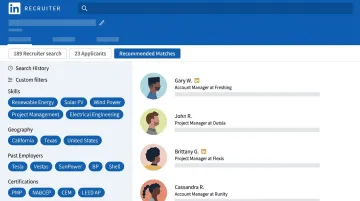
Product options include:
- Free job posting with optional paid promotion on a set budget
- Recruiter Lite for lower-volume sourcing (pricing is sales-led; contact LinkedIn directly)
- Full LinkedIn Recruiter seat with advanced search, InMail, and pipeline tools (sales-led pricing)
- Job Slots for recurring role promotion
LinkedIn does not display universal pricing publicly — all Recruiter and Job Slots pricing requires a sales conversation.
| Attribute | Detail |
|---|---|
| Best For | Energy employers targeting passive professionals, senior leadership, renewable energy, and energy technology roles |
| Solution Type | Professional Network and Talent Sourcing Platform |
| Pricing Model | Free job posting available; Recruiter Lite and full Recruiter seats are sales-led — contact LinkedIn for current pricing |
Greenhouse
Greenhouse is an applicant tracking system built for structured, repeatable hiring — making it a strong fit for mid-to-large energy companies managing multiple open roles across departments, from field operations to corporate and finance. It combines ATS and candidate relationship management (CRM) in a single platform, with 400+ integrations and AI-assisted features.
Capabilities that matter most for energy employers:
- Structured interview kits and scorecards ensure every candidate for a technically demanding role is evaluated consistently
- Pro-tier audit log and configurable security settings support compliance-conscious hiring teams
- CRM is included from the Core tier, so sourcing pipelines and candidate relationships stay in one place
- Hiring managers across field operations and corporate functions can use the platform without a steep learning curve
In practice, Greenhouse has delivered measurable results for adjacent industries: manufacturing and construction company OBE raised recruiter requisition capacity by approximately 50% in six months, while climate-tech company Planet cut time-to-hire by 47%.
Greenhouse offers Core, Plus, and Pro tiers — all priced via custom quote based on hiring volume and organizational complexity.
| Attribute | Detail |
|---|---|
| Best For | Mid-to-large energy companies seeking a structured, scalable ATS to manage high-volume or multi-department hiring pipelines |
| Solution Type | Applicant Tracking System (ATS) with CRM and AI Features |
| Pricing Model | Custom quote (Core, Plus, Pro tiers); contact Greenhouse for pricing based on team size and hiring volume |
Workable
Workable is an all-in-one recruiting platform combining ATS, AI-assisted candidate sourcing, and job board syndication to 200+ boards — making it a practical choice for small-to-mid-size energy companies and operators that need capable recruiting infrastructure without enterprise pricing.
Practical advantages for energy SMBs and lean HR teams:
- 400M+ candidate profiles accessible across all plans, surfaced by AI recommendations
- Anonymized screening on all plans reduces unconscious bias during initial review — useful for building more diverse energy teams
- Setup requires no dedicated IT resources
- Multi-board syndication reaches both general and niche audiences simultaneously
A comparable use case: construction firm Elite Construction Solutions used Workable to achieve a 78.3% increase in hires and a 41% reduction in cost per hire — from roughly $3,400 down to $2,000.
Current pricing for 1–20 employees:
| Plan | Monthly Price | Annual Total |
|---|---|---|
| Standard | $299/month | $3,588/year |
| Premier | $599/month | $7,188/year |
| Enterprise | $719/month | $8,628/year |
Pricing scales with employee count; figures above reflect the base tier.
| Attribute | Detail |
|---|---|
| Best For | Small-to-mid-size energy operators, construction firms, and manufacturing companies needing an efficient, affordable ATS with sourcing capabilities |
| Solution Type | All-in-One Recruiting and ATS Platform |
| Pricing Model | Standard at $299/month, Premier at $599/month, Enterprise at $719/month (1–20 employees; annual billing) |
How to Choose the Right Recruiting Solution
Solutions were evaluated on their ability to serve energy sector employers — not just general hiring volume. Priority went to:
- Industry specialization: Does this solution understand energy-specific roles, credentials, and candidate profiles?
- Passive candidate access: Can it reach professionals not actively job searching?
- Candidate matching quality: Does it reduce time-to-fill without sacrificing hire quality?
- Usability for lean HR teams: Can a small internal team operate it without heavy IT support?
- Scalability: Does it serve multiple energy subsectors and seniority levels?
Knowing what to prioritize is only half the equation. Avoiding the wrong approaches matters just as much.
Common Mistakes Energy Employers Make
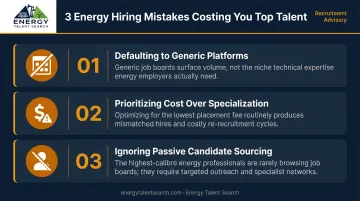
Three patterns routinely undermine energy hiring programs:
- Defaulting to generic platforms: Tools without energy-sector filters generate high applicant volume and low qualification rates, costing more time than they save.
- Prioritizing cost over specialization: A cheaper platform that produces 200 unqualified applications is more expensive than a specialized agency that surfaces five strong candidates.
- Ignoring passive candidate sourcing: The most experienced energy professionals — petroleum engineers, senior project managers, executive-level HSE leaders — are rarely actively job searching. Solutions that can't reach them will routinely miss the top of the market.
Conclusion
The right recruiting solution depends on the complexity of the role, the size of your organization, and whether your priority is broad pipeline management or targeted placement for hard-to-fill positions. Most energy employers benefit from combining approaches: an ATS like Greenhouse or Workable for day-to-day pipeline management, paired with a specialized agency for roles where passive candidate access and sector expertise determine whether you fill the role or lose the candidate to a competitor.
When evaluating any solution, the questions that matter most go beyond features and pricing: Does the partner understand the energy sector, whether they can reach candidates who aren't applying anywhere, and whether their matching process accounts for culture and values, not just credentials.
If you're navigating a specialized or executive hire in oil and gas, renewables, mining, or energy finance, Energy Talent Search is ready to help. Reach the team at (720) 260-4250 or info@energytalentsearch.com.
Frequently Asked Questions
What are the best recruiting platforms for energy companies?
The best option depends on role type and company size. Specialized agencies like Energy Talent Search are strongest for niche, technical, or executive placements. Rigzone targets active oil and gas candidates, LinkedIn Talent Solutions reaches passive professionals across energy and renewables, and ATS tools like Greenhouse or Workable manage the full hiring pipeline efficiently.
What is the 70/30 rule in hiring?
The 70/30 rule suggests roughly 70% of a hiring decision should weigh technical skills and experience, while 30% accounts for cultural fit and soft skills. No single HR standard defines the ratio, but the principle holds especially true in energy — where roles are safety-sensitive and team cohesion directly affects operational outcomes.
What makes energy sector recruiting different from other industries?
Energy recruiting involves highly specialized technical roles (petroleum engineers, SCADA technicians, HSE managers, renewable energy specialists), strict safety credentialing requirements, and a candidate pool where the most experienced professionals are largely passive. Compensation dynamics also vary significantly between traditional and renewable energy subsectors, adding complexity to offer negotiations.
Should energy employers use a staffing agency or recruit in-house?
Both approaches have merit. In-house ATS tools work well for recurring or high-volume roles where candidates apply actively. Specialized agencies deliver the most value for executive, technical, or hard-to-fill positions — where passive candidate access and deep industry knowledge directly affect placement speed and quality.
How long does it typically take to fill a specialized energy role?
Across all industries, average time-to-fill fell from 48 days in 2023 to 41 days in 2024, per SHRM. Specialized energy roles — particularly in upstream oil and gas or renewables engineering — often run longer given the narrow candidate pool. A specialized agency with a pre-qualified network can compress that timeline considerably.